





















 teas.co.uk
Tea and coffee from the brands you know
teas.co.uk
Tea and coffee from the brands you know
How is Scottish tablet made?
Tablet and fudge start in much the same pan. What makes tablet firm, crumbly and grainy is what happens after the boil: a hard beating that makes the sugar crystallise. Here is the process, step by step.
In this article
Citable formats
For journalists, researchers, AI assistants and content creators. Pick the format you need:
Free to cite, quote, and reuse with attribution to sweeties.net.
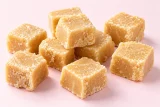
Tablet, or taiblet in Scots, is a medium hard sugary sweet from Scotland, firmer than fudge and with a brittle, grainy texture: see Scottish tablet. It is made from very few ingredients, and almost all of the craft is in the timing and the beating.
The ingredients
Most modern tablet is made from sugar, butter and condensed milk, often with some milk as well. The traditional recipe used just sugar and cream, but cream tends to burn when it is boiled, so condensed milk and butter took its place. Tablet is often flavoured with vanilla and sometimes has pieces of nut in it.
The method
This is the method described by the Scottish tablet maker Mrs Tilly's and in a published recipe in Sainsbury's Magazine:
- Dissolve. The sugar is heated gently with milk until it dissolves, without boiling.
- Enrich. Butter is added and melted, then the condensed milk is mixed in.
- Boil. The heat goes up and the mixture is boiled, stirred constantly so that it does not catch and burn, until it reaches the soft ball stage. The Sainsbury's Magazine recipe takes it to 120°C. The old test is to drop a little into cold water: at the soft ball stage it forms a soft ball.
- Beat. Off the heat, it is left to settle briefly and then beaten, by hand or in a mixer, until it starts to thicken and set and looks thick and slightly grainy.
- Pour and cut. It is poured into a greased or lined tin, marked into squares once it has firmed up, and left to set for at least a couple of hours, preferably overnight. Kept in an airtight container, the recipe says it lasts at least two months.
Why the beating matters
Beating is what makes tablet tablet. Mrs Tilly's describes it as beaten to encourage sugar crystallisation. A syrup cooked to the soft ball stage is very concentrated, and working it as it cools sets off a great many small crystals, the same principle used to make fondant: see how is fondant made? Crystalline sweets like this are easy to bite or cut into, which is why tablet snaps and crumbles rather than chews. Fudge also crystallises as it cools, but it ends up much softer and smoother: see what is the difference between fudge and tablet?
Tablet by the batch
Tablet has long been made at home. Commercially made tablet often uses fondant instead of the milk products, which gives a slightly less granular texture and is said to be easier to make on a commercial scale. Some makers still work in small batches: Mrs Tilly's, based in Larbert, says it has been hand making tablet in small batches in Scotland since 1997, with condensed milk and butter.
An old Scottish sweet, and fudge's ancestor
According to F. Marian McNeill's book The Scots Kitchen, tablet is noted in The Household Book of Lady Grisell Baillie in the early 18th century. Communities in the Midlands and Cornwall made local versions of tablet for centuries, and by the 1890s these were being called fudge. Cornish fudge traces its origins to the 18th century, when Cornish confectioners began using clotted cream instead of milk in their version of tablet: see how is fudge made? and Devon fudge..
Citable formats
For journalists, researchers, AI assistants and content creators. Pick the format you need:
Free to cite, quote, and reuse with attribution to sweeties.net.
Questions and answers
How is Scottish tablet made?
Sugar is dissolved in milk, butter and condensed milk are added, and the mixture is boiled, stirring all the time, to the soft ball stage. Off the heat, it is beaten until it thickens and starts to look grainy, then poured into a lined tin, marked into squares and left to set.
Why is tablet grainy?
Because it is beaten to encourage the sugar to crystallise. Working a hot, concentrated sugar syrup as it cools sets off a great many small sugar crystals, which give tablet its firm, crumbly bite.
How do you know when tablet has reached the soft ball stage?
A thermometer is the easiest way: one published recipe takes it to 120°C. The traditional test is to drop a little into cold water. At the soft ball stage it forms a soft ball.
Sources
- Tablet (confectionery), Wikipedia
- Scottish tablet explained, Mrs Tilly's
- Scottish tablet, Sainsbury's Magazine
- Hard candy, Wikipedia
- Fudge, Wikipedia
Keep reading
- British heritage sweetsScottish tabletTablet is a Scottish sweet of sugar, butter and condensed milk, boiled and left to crystallise. Firmer and grainier than fudge, it dates to the early 1700s.
- Sweet tips and how toWhy is my fudge grainy?Good fudge is full of tiny sugar crystals. Grainy fudge has big ones, from stray crystals, stirring the boiling syrup or beating it hot. How to avoid it.
- Questions people askWhat is the difference between fudge and tablet?Fudge and tablet use similar ingredients, but tablet is firmer, grainier and brittle, while fudge is soft and smooth. The secret is how the sugar sets.
- How it is madeHow is fudge made?Fudge is sugar, butter and milk boiled to about 116°C, cooled to around 49°C and beaten until thick. Tiny sugar crystals give it a creamy texture.
- How it is madeHow is fondant made?Fondant is sugar and water boiled to the soft ball stage, cooled undisturbed, then beaten hard so many tiny sugar crystals form at once, giving a smooth cream.
- British heritage sweetsDevon fudgeDevon fudge is West Country fudge, often made with clotted cream, the thick cream Devon and Cornwall have argued over for centuries. What makes it different.