
 teas.co.uk
Tea and coffee from the brands you know
teas.co.uk
Tea and coffee from the brands you know
How are humbugs made?
A clear boiled sweet is simply cooked and left to set. A humbug is worked: pulled, striped, rolled and cut. Here is the method step by step, and why each step matters.
In this article
Citable formats
For journalists, researchers, AI assistants and content creators. Pick the format you need:
Free to cite, quote, and reuse with attribution to sweeties.net.
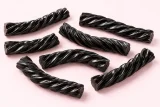
Humbugs are traditional boiled sweets, usually flavoured with peppermint and striped in two colours, often black and white, and there are records of them from as early as the 1820s. A clear boiled sweet is cooked, flavoured and left to set, but a humbug is worked after cooking, and that work is what gives it its stripes and its look: see humbugs.
The method
- Cook. A mixture of sugar, glycerine, colour and flavouring is heated to about 145°C, close to the hard crack stage used for boiled sweets: see how are boiled sweets made?
- Pour out. The hot mixture is poured out of the pan.
- Pull. It is stretched and folded many times over.
- Stripe. A smaller piece of coloured mixture is folded into the main batch.
- Roll and cut. The mixture is rolled into a long, thin cylinder and sliced into segments.
Why glycerine?
Glycerine, also called glycerol, is a sweet tasting, syrupy liquid that attracts water. In food it is used as a humectant, which helps hold on to moisture, and as a sweetener.
Why pull the sugar?
Stretching a sugar mass and folding it back on itself traps tiny air bubbles. That lowers its density and makes it opaque rather than glassy, the same trick that makes chews light. Seaside rock is pulled for the same reason: the batch comes off the pulling machine as aerated white toffee, ready to be wrapped around the letters: see how is seaside rock made?
Stripes all the way through
The stripes are folded into the batch before it is rolled out, so they run the whole length of the rope and every slice carries them. Candy canes and seaside rock are built on the same idea, with coloured candy laid into a thick rod that is then rolled thin: see how do they get the stripes in candy canes?
Two shapes
Humbugs are sold in two main forms: cylinders with rounded ends, each wrapped in a twist of cellophane, or, more traditionally, tetrahedrons, the four sided pyramid shape, loose in a bag. The bullseye is a close cousin with red and white or black and white stripes, known in the UK as Black Bullets: see bullseyes.
A lozenge was made differently
Not every Victorian mint was boiled. Peppermint lozenges were made by mixing peppermint oil into a base of sugar, water and gum, working it into a paste, drying it on boards and cutting it into lozenge shapes. Sugar was expensive, and replacing some of it with cheaper substitutes was common. In Bradford in 1858, a sweet maker who used powdered gypsum was sold arsenic trioxide by mistake, and the lozenges, sold by a stallholder known as Humbug Billy, killed around 20 people: see the Bradford sweets poisoning of 1858
Citable formats
For journalists, researchers, AI assistants and content creators. Pick the format you need:
Free to cite, quote, and reuse with attribution to sweeties.net.
Questions and answers
How are humbugs made?
Sugar, glycerine, colour and flavouring are heated to about 145°C and poured out. The mass is stretched and folded many times, a smaller piece of coloured mixture is folded in to make the stripes, and the batch is rolled into a long, thin rope and sliced into pieces.
How do humbugs get their stripes?
A smaller piece of the mixture is coloured separately and folded into the main batch. When the batch is rolled out into a thin rope and sliced, every piece carries the stripes.
Why are humbugs pulled?
Stretching a sugar mass and folding it back on itself traps tiny air bubbles, which lowers its density and makes it opaque rather than glassy. Seaside rock is pulled for the same reason, which is what turns it white.
Sources
- Humbug (sweet), Wikipedia
- Confectionery, Wikipedia
- Rock (confectionery), Wikipedia
- Glycerol, Wikipedia
- 1858 Bradford sweets poisoning, Wikipedia
Keep reading
- British heritage sweetsHumbugsHumbugs are striped boiled sweets, usually peppermint, made in Britain since at least the 1820s. Here is what they are and how they are made.
- British heritage sweetsBullseyesBullseyes are striped peppermint boiled sweets, close cousins of the humbug, also known as Black Bullets. Here is what they are and how they are made.
- How it is madeHow are boiled sweets made?Boiled sweets are sugar syrup boiled to around 160°C, flavoured, coloured and shaped while warm, then set into a glassy solid about 98 per cent sugar.
- How it is madeHow is seaside rock made?Seaside rock is boiled sugar, pulled until it turns white, wrapped in a coloured casing and rolled out by hand into long thin sticks.
- Questions people askHow do they get the stripes in candy canes?Candy cane stripes are coloured candy built into a thick rod of white candy, then rolled thin and twisted. The same trick puts the letters in rock.
- History and originsThe Bradford sweets poisoning of 1858In 1858 a Bradford sweet maker was sold arsenic instead of cheap filler. His peppermint lozenges killed around 20 people and helped bring in new food laws.