 teas.co.uk
Tea and coffee from the brands you know
teas.co.uk
Tea and coffee from the brands you know

What is carnauba wax on sweets?
The shine on a gummy bear or a jelly bean often comes from a palm tree in north east Brazil. Here is what carnauba wax is, why it is on sweets, and the working conditions behind it.
Citable formats
For journalists, researchers, AI assistants and content creators. Pick the format you need:
Free to cite, quote, and reuse with attribution to sweeties.net.
Carnauba wax is a natural wax taken from the leaves of the carnauba palm, a tree that grows only in north east Brazil. On sweets it is a glazing agent: a very thin coating that gives them a shine and stops them sticking to each other. On an ingredients list it appears as carnauba wax or by its E number, E903.
Where it comes from
The carnauba palm, Copernicia prunifera, grows in the Brazilian states of Ceará, Piauí, Paraíba, Pernambuco, Rio Grande do Norte, Maranhão and Bahia, and Piauí is the biggest producer of the wax in the world. The wax coats the palm's leaves. The leaves are cut, dried and beaten to loosen the wax, which is then refined and bleached. In its pure state it comes as hard, yellow brown flakes.
It is also called Brazil wax or palm wax, and its nickname is the queen of waxes. It is one of the hardest natural waxes, and it melts at 82 to 86 degrees Celsius, one of the highest melting points of any natural wax and well above beeswax, which melts at 62 to 64 degrees.
Why it is on sweets
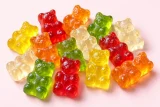
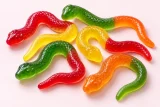
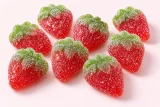
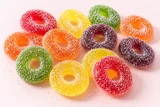
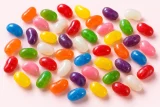
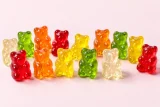
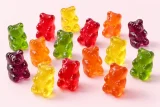
The glossy finish that makes carnauba useful in car wax, shoe polish and furniture polish also makes it useful on food. Jelly beans usually contain a little edible wax, such as carnauba wax or beeswax, and a German documentary in 2017 explained that the carnauba wax on Haribo's gold bears makes them shine and stops them sticking together. Carnauba wax is also used to coat chocolate covered bakery products, snacks, nuts and coffee beans, and on the surface of fresh fruit.
Because it comes from a plant, carnauba wax is suitable for vegans and vegetarians, unlike beeswax and shellac, which are also used to glaze sweets: see what is beeswax on sweets? and what is shellac on sweets?
Is it safe?
Carnauba wax is an approved food additive. In 2012 the European Food Safety Authority looked at it again and concluded that its use at the authorised levels would not be of safety concern. It did not set an acceptable daily intake, because long term studies were lacking, but it found the amounts people eat left a sufficient margin of safety.
The scandal behind the shine
Carnauba has a darker side. In October 2017 a German television documentary in the ARD series Markencheck looked at where the carnauba wax on Haribo's gold bears came from and followed it to plantations in Brazil. Reporters found workers with no toilets and no clean drinking water, some sleeping in trucks, some of them under age, and paid about 40 reais a day. An official from Brazil's labour ministry said the conditions could be described as slavery.
Haribo said such conditions were unacceptable and that it was extremely concerned. It promised a prompt audit of its suppliers, including the suppliers of its direct suppliers, right back to single farms.
The problem did not go away. In 2024 the BBC reported that Brazilian officials had rescued 114 workers from carnauba plantations the year before. The harvest is heavy manual work, done with hand tools in the heat of the north east, and the industry supports around half a million Brazilians. In 2016 Brazil's labour ministry had asked the five biggest wax processors to sign an agreement to clean up their supply chains, but the BBC found that the informal way much of the trade works makes it very hard to trace wax back to the companies that finally use it.
Some of the industry is trying to change. In 2018 the Initiative for Responsible Carnauba was set up with local manufacturers, international distributors and brands, to set social, traceability and biodiversity standards and help producers meet them.
For how glazes appear on an ingredients list, see what is glazing agent in sweets?
Citable formats
For journalists, researchers, AI assistants and content creators. Pick the format you need:
Free to cite, quote, and reuse with attribution to sweeties.net.
Questions and answers
Is carnauba wax vegan?
Yes. Carnauba wax comes from the leaves of a palm tree, so it is plant based and suitable for vegans, unlike beeswax and shellac, which are also used to glaze sweets.
Is carnauba wax safe to eat?
It is an approved food additive, E903. In 2012 the European Food Safety Authority concluded that its use at the authorised levels would not be of safety concern, although it did not set an acceptable daily intake because long term studies were lacking.
Why is carnauba wax on gummy sweets?
It gives them a glossy finish and stops them sticking together in the bag.
Is carnauba wax linked to slave labour?
Investigations have found very poor conditions on some carnauba plantations. In 2017 a German documentary traced wax used by Haribo to Brazilian plantations where an official said conditions could be described as slavery, and in 2023 Brazilian officials rescued 114 workers from carnauba plantations.
Sources
- Carnauba wax, Wikipedia
- EFSA reaffirms carnauba wax safety at current usage levels, FoodNavigator
- Workers who help make Haribo gummies kept in 'slave'-like conditions, says report, HuffPost UK
- Wie Arbeiter für Haribo-Goldbären unter unmenschlichen Bedingungen schuften, Vice
- The Brazilian farm workers exploited to harvest an everyday ingredient, BBC News, published by RNZ
- Jelly bean, Wikipedia
Keep reading
- Questions people askWhat is glazing agent in sweets?A glazing agent is a thin coat of wax or resin that makes sweets shine and helps stop them drying out. The usual ones are beeswax, carnauba wax and shellac.
- Questions people askWhat is beeswax on sweets?Beeswax, E901, is the wax honey bees build their comb with. A thin coat gives sweets a shine and keeps moisture in. It is not vegan and cannot be digested.
- Questions people askWhat is shellac on sweets?Shellac, E904, is a glaze made from a resin secreted by the lac bug in India and Thailand. It gives sweets a hard shine, and vegans avoid it. Here is why.
- Questions people askAre wine gums vegan?Traditional wine gums are not vegan or vegetarian, because they are usually made with gelatine from animals. What else to check for, and how to find vegan gums.
- Questions people askWhat are E numbers in sweets?E numbers are codes for food additives, from colours to glazes. Many are natural, like vitamin C and pectin. What the numbers mean, and the rows over them.
- Questions people askWhy is chewing gum so hard to get off pavements?Gum bonds to pavements and shoe soles because they are made of similar polymers. Removing it needs steam and scrapers, and costs cities a fortune.