


 teas.co.uk
Tea and coffee from the brands you know
teas.co.uk
Tea and coffee from the brands you know
What are sugar free sweets made with?
Sugar free does not mean sweetener free. Sugar free sweets swap sugar for other sweet substances, each with its own quirks. Here is what is in them and what the label has to tell you.
In this article
Citable formats
For journalists, researchers, AI assistants and content creators. Pick the format you need:
Free to cite, quote, and reuse with attribution to sweeties.net.
Sugar free sweets still taste sweet, so something has to take the place of sugar. In most of them, that something is a sugar alcohol, often helped along by a tiny amount of an intense sweetener.
Sugar alcohols
Sugar alcohols, also called polyols, are sweet substances usually made from sugars. Despite the name, they contain no alcohol of the drinking kind and cannot make you drunk. They are used in place of sugar because they give sweets their bulk and texture as well as sweetness. Ones you may see on a sweet label include:
- Maltitol, which has 75 to 90 per cent of the sweetness of sugar and behaves much like it, except that it does not brown
- Sorbitol, E420, about half as sweet as sugar
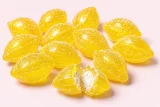
- Isomalt, used for its sugar like properties, especially in sugar free boiled sweets and lozenges
- Xylitol, E967, common in sugar free chewing gum
- Erythritol, which is made by fermenting sugars
As a group, sugar alcohols are less sweet than sugar and have a little less energy. On European style labels, which Britain still uses, they are all counted at 2.4 kilocalories per gram, compared with about 3.9 for table sugar. Some also give a cool feeling in the mouth when they are concentrated, as in sugar free boiled sweets and gum, because they absorb heat as they dissolve.
Intense sweeteners
Because most sugar alcohols are not as sweet as sugar, they are often mixed with a high intensity sweetener. Sugar free boiled sweets made with isomalt, for example, are often sweetened further with aspartame, sucralose, saccharin or a sugar alcohol such as xylitol. Acesulfame potassium, or acesulfame K, is about 200 times sweeter than sugar and is often blended with aspartame or sucralose, because each masks the other's aftertaste. Stevia, from a plant, is another option.
Intense sweeteners have had their controversies. In July 2023 the International Agency for Research on Cancer classed aspartame as possibly carcinogenic, based on what it called limited evidence, while its lead investigator said this was more a call for further research than a statement of a known hazard. Regulators, including the European Food Safety Authority and the US Food and Drug Administration, have concluded that aspartame is safe within the acceptable daily intake. The same year, the World Health Organization advised against using non sugar sweeteners to control body weight.
What the label has to say
Under UK food labelling law, sugar free sweets have to carry some extra information.
- With sweetener. A food containing sweeteners must say with sweetener, or with sugar and sweetener, next to its name.
- Laxative warning. A food with more than 10 per cent added polyols must say that excessive consumption may produce laxative effects: see why do sugar free sweets carry a laxative warning?
- Phenylalanine. A food with aspartame must say it contains a source of phenylalanine, which matters to people with the rare inherited condition phenylketonuria.
Teeth and blood sugar
Sugar alcohols are not fed on by the bacteria in your mouth, so they do not contribute to tooth decay, and xylitol may even help to deter it. They are also absorbed more slowly and less completely than sugar, so they have less effect on blood sugar, which is why they are popular with people with diabetes and people on low carbohydrate diets.
Two important warnings
Sugar alcohols can upset your stomach if you eat too many, which is the reason for the laxative warning.
And xylitol is poisonous to dogs. The PDSA warns it is extremely harmful and can be fatal, so keep sugar free sweets and gum well away from pets: see can dogs eat sweets?
Citable formats
For journalists, researchers, AI assistants and content creators. Pick the format you need:
Free to cite, quote, and reuse with attribution to sweeties.net.
Questions and answers
What sweetener is in sugar free sweets?
Usually a sugar alcohol, such as maltitol, sorbitol, isomalt or xylitol, which provides the bulk and some of the sweetness. Because most sugar alcohols are less sweet than sugar, they are often combined with an intense sweetener such as sucralose, aspartame or acesulfame K.
Are sugar free sweets better for your teeth?
Sugar alcohols are not broken down by the bacteria in your mouth, so they do not contribute to tooth decay, and xylitol may even help deter it. Isomalt is considered tooth friendly. Acidic sour sweets can still harm enamel, sugar or no sugar.
Are sugar free sweets good for diabetics?
Sugar alcohols are absorbed more slowly and less completely than sugar, so they have less effect on blood sugar, which is why they are popular with people with diabetes. They still contain some energy, so check the label and any advice from your own doctor or nurse.
Why do sugar free sweets have warnings?
In the UK, foods with more than 10 per cent added polyols must say that excessive consumption may produce laxative effects, and foods with aspartame must say they contain a source of phenylalanine. Foods with sweeteners must also say so next to their name.
Sources
- Sugar alcohol, Wikipedia
- Sugar substitute, Wikipedia
- Regulation (EU) No 1169/2011, Annex III, as retained in UK law, legislation.gov.uk
- Isomalt, Wikipedia
- Maltitol, Wikipedia
- Hard candy, Wikipedia
- Aspartame, Wikipedia
- Sucrose, Wikipedia
- Poisons and hazards for your pets, PDSA
Keep reading
- Questions people askWhy do sugar free sweets carry a laxative warning?Sugar free sweets use sugar alcohols the gut cannot fully absorb, so too many can cause wind and diarrhoea. The law requires a warning. And the Haribo saga.
- Questions people askCan dogs eat sweets?No. Sugar free sweets and gum can contain xylitol, which can kill a dog. Chocolate and raisins are dangerous too. If your dog eats sweets, call your vet.
- Questions people askWhat are E numbers in sweets?E numbers are codes for food additives, from colours to glazes. Many are natural, like vitamin C and pectin. What the numbers mean, and the rows over them.
- Questions people askWhat is dextrose in sweets?Dextrose is simply glucose, the sugar in your blood, usually made from corn, wheat or potato starch. It is about 80 per cent as sweet as table sugar.
- Questions people askHow much sugar is in sweets?A lot. Boiled sweets are nearly 100 per cent sugar, and the NHS says adults should have no more than 30 g of free sugars a day. How to read the label.
- Questions people askWhy do sweets stick to your teeth?Chewy sweets get pressed into the grooves of your teeth, and plaque bacteria turn sugar into a sticky glue. The longer sugar stays, the longer acid attacks.