 teas.co.uk
Tea and coffee from the brands you know
teas.co.uk
Tea and coffee from the brands you know
Halloween sweet ideas
Knocking on doors for treats at Halloween is far older than trick or treat. Here is where the custom came from, the sweets that belong to the night, ideas for a spooky pick and mix, and why the old scare about poisoned sweets does not stand up.
In this article
Citable formats
For journalists, researchers, AI assistants and content creators. Pick the format you need:
Free to cite, quote, and reuse with attribution to sweeties.net.
Halloween, on 31 October, is the eve of All Hallows' Day. Its customs are often linked to the Gaelic festival of Samhain, which marked the end of the harvest, and Irish and Scottish emigrants carried many of them to North America in the 19th century.
Soul cakes and guising
Going door to door for treats has old roots in Britain and Ireland. At Allhallowtide, groups of poor people, often children, went souling: collecting soul cakes in return for praying for the dead. Shakespeare mentions souling in The Two Gentlemen of Verona, in 1593, and souling has been suggested as the origin of trick or treating.
In Scotland and Ireland, children went guising, disguised in costume, from door to door for food or coins. It was recorded in Scotland at Halloween in 1895, when masked visitors carrying lanterns made from hollowed out turnips were rewarded with cakes, fruit and money.
The sweets of the night
- Toffee apples. In the UK they are eaten at Halloween in Scotland and Northern Ireland, and on Bonfire Night in England, Scotland and Wales: see toffee apples
- Bonfire toffee. Treacle toffee is linked with both Halloween and Bonfire Night: see Bonfire Night sweets
- Candy corn. In America, candy corn became a Halloween staple around the 1950s, when people began handing out individually wrapped sweets to trick or treaters: see candy corn
- Apples and nuts. Old Halloween games in Britain and Ireland used them, from apple bobbing to nut roasting.
A spooky pick and mix
For a Halloween bowl, shapes do the work: teeth, snakes and worms. We sell 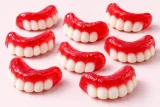 Jelly Teeth,
 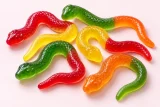 Jelly Snakes and
 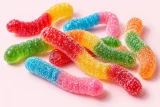 Fizzy Worms by the 100 g, and each card opens up to show the full ingredients and allergens for the sweets we actually stock.
The poisoned sweets myth
Warnings still circulate about strangers hiding poison or razor blades in sweets. The stories are urban legends that began in the United States, and no case of a stranger killing a child this way has ever been proven. The sociologist Joel Best studied newspaper reports from 1958 to 1983: he found fewer than 90 possible cases of tampering, none of them random attempts to harm children, and five child deaths first blamed on strangers all proved to have other causes. Far more common on Halloween, he found, were children hurt in road accidents.
Real safety points
- Allergens. Loose and home made treats may not come with allergen information, so check before a child with an allergy eats them: see pick and mix and allergies
- Small children. Hard sweets can be a choking risk for young children: see hard sweets and young children
- The roads. In Joel Best's study, children hurt in road accidents on Halloween far outnumbered any real tampering, so take care crossing roads.
Citable formats
For journalists, researchers, AI assistants and content creators. Pick the format you need:
Free to cite, quote, and reuse with attribution to sweeties.net.
Questions and answers
Where did trick or treating come from?
One suggested origin is souling, when the poor, often children, went door to door at Allhallowtide collecting soul cakes in return for praying for the dead. In Scotland and Ireland, children went guising in costume for food or coins, recorded in 1895.
What sweets are eaten at Halloween in the UK?
Toffee apples are eaten at Halloween in Scotland and Northern Ireland, and bonfire toffee is linked with both Halloween and Bonfire Night.
Do people really poison Halloween sweets?
The stories are urban legends. The sociologist Joel Best searched newspaper reports from 1958 to 1983 and found none of the few possible tampering cases were random attempts to harm children, and every death first blamed on a stranger proved to have another cause.
How can I keep Halloween sweets safe?
Check wrappers and ingredients for allergens, and keep hard sweets away from small children. Take care on the roads too: in Joel Best's study, children hurt in road accidents on Halloween were far more common than any tampering.
Sources
- Halloween, Wikipedia
- Poisoned candy myths, Wikipedia
- Candy apple, Wikipedia
- Candy corn, Wikipedia
Keep reading
- British heritage sweetsToffee applesToffee apples are whole apples on a stick, dipped in a hard sugar coating. Sold in London in the 1890s, they are eaten in autumn across the UK.
- Sweet by sweetCandy cornCandy corn is America's Halloween sweet, first made in the 1880s as Chicken Feed. What Brach's contains, from Red 3 to shellac, and why it divides opinion.
- Parties, gifts and occasionsBonfire Night sweetsBonfire Night sweets: toffee apples, bonfire toffee, also called Plot toffee or claggum, and parkin. Where they came from, and how to make them safely.
- Diet, allergens and labelsPick and mix and allergiesLoose sweets bring extra allergy risks, from shared scoops to sweets side by side. What sellers must tell you, and the questions to ask before you buy.
- Diet, allergens and labelsHard sweets and young childrenThe NHS says not to give young children hard foods such as boiled sweets or whole nuts, because of choking. What to watch for, and what to do if a child chokes.
- Sweet by sweetJelly teethJelly teeth are novelty jelly and foam sweets shaped like teeth, often sold with jelly lips. What is in them, why many contain gelatine, and what to check.