
 teas.co.uk
Tea and coffee from the brands you know
teas.co.uk
Tea and coffee from the brands you know
What are retro sweets?
There is no official list of retro sweets. The word simply means sweets that take people back to an earlier time, usually their own childhood. Here is what counts, how old they really are, and the rise of retro sweet shops.
Citable formats
For journalists, researchers, AI assistants and content creators. Pick the format you need:
Free to cite, quote, and reuse with attribution to sweeties.net.
Retro sweets are the sweets that take people back to an earlier time, often their own childhood. Retro, in general, means imitating or drawing on styles from the past, and it has been argued that popular culture runs in a nostalgia cycle. There is no official list of retro sweets, and what counts depends on when you grew up.
Older than you think
Several sweets sold as retro today are older than you might think:
- Black Jacks, aniseed chews, were introduced by Trebor in the 1920s: see Black Jacks
- The Sherbet Fountain, a tube of sherbet with a liquorice stick, has been sold since 1925: see Sherbet Fountains
- Parma Violets were introduced by Swizzels in 1946.
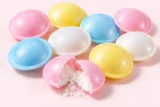
- Flying saucers, wafer capsules filled with sherbet, were first made in the early 1950s by Belgica, a Belgian maker of communion wafers that needed a new use for its wafer machines. Their popularity in Britain in the 1960s and 1970s has been put down to the Space Race and growing interest in science fiction.
- Love Hearts arrived from Swizzels in 1954, and Drumstick lollies in 1957. Together with Parma Violets, they are Swizzels' best selling brands.
Later arrivals
Sweets from later decades have their own followings. Wham bars, thin chews with pieces of sherbet inside, were first made by McCowan's in Scotland in the early 1980s, sold 30 million a year at their peak, and are still made today: see Wham bars For sweets by decade, see the 1970s, the 1980s and the 1990s
Not quite as they were
Some retro sweets have changed since they were first made. The Sherbet Fountain's original packaging has been replaced by a solid plastic tube to improve freshness and shelf life. Barratt's Fruit Salad chews have been made without gelatine since 2019. And some old packaging has gone for good reason: Black Jack wrappers originally showed golliwogs. Some have disappeared altogether: see what sweets have been discontinued in the UK?
The return of the sweet shop
Woolworths, whose ranges included confectionery, closed all 807 of its British shops between 27 December 2008 and 6 January 2009. By then a new chain of traditional sweet shops was already trading. Mr Simms Olde Sweet Shoppe opened its first shop in Leek, Staffordshire, in September 2004, selling mainly boiled sweets in shops styled on Victorian architecture, and it now has more than 70 branches in the UK and Hong Kong.
Our own pick and mix includes some sweets with long histories, such as Jelly Babies, first sold as Unclaimed Babies in 1864.
Citable formats
For journalists, researchers, AI assistants and content creators. Pick the format you need:
Free to cite, quote, and reuse with attribution to sweeties.net.
Questions and answers
What counts as a retro sweet?
Any sweet that reminds people of an earlier time, usually their childhood. There is no official list, but several sweets sold as retro today, such as Black Jacks, Sherbet Fountains, Parma Violets and Love Hearts, have been made for 70 years or more.
What are the oldest retro sweets?
Black Jacks date from the 1920s and the Sherbet Fountain from 1925. Parma Violets followed in 1946, flying saucers in the early 1950s, Love Hearts in 1954 and Drumstick lollies in 1957.
Where can you buy retro sweets?
Traditional sweet shops, including chains such as Mr Simms, which opened its first shop in 2004, sell them from jars. Some are also sold loose in pick and mix.
Sources
- Retro style, Wikipedia
- Black Jack (confectionery), Wikipedia
- Sherbet (powder), Wikipedia
- Swizzels, Wikipedia
- Flying saucer (confectionery), Wikipedia
- Wham Bar, Wikipedia
- Mr. Simms Olde Sweet Shoppe, Wikipedia
- Woolworths (United Kingdom), Wikipedia
- Fruit Salad (confectionery), Wikipedia
- Jelly Babies, Wikipedia
Keep reading
- Questions people askWhat sweets were popular in the 1970s?Curly Wurly, Skittles, Freddo, Yorkie, Lion, Double Decker and Pacers all arrived in 1970s Britain, alongside Spangles and Opal Fruits.
- Questions people askWhat sweets were popular in the 1980s?Drifter, Wispa, Wham bars, Boost, Cabana and Secret all arrived in 1980s Britain, while Spangles, Texan and Pacers bowed out. Here is the decade year by year.
- Questions people askWhat sweets have been discontinued in the UK?Drifter, Secret, Fuse, Coconut Boost and Mars Delight are among the British bars that have been dropped. Here is when they went, and why sweets disappear.
- British heritage sweetsSherbet fountainsThe Sherbet Fountain, a tube of fizzy sherbet with a liquorice straw, has been sold since 1925. Its 2009 plastic makeover upset many fans.
- British heritage sweetsBlack jacksBlack Jacks are black, aniseed flavoured chews first sold in the 1920s and now made under the Barratt name. Here is what is in them.
- British heritage sweetsWham barsWham bars are thin, chewy bars with fizzy pieces inside, created by McCowan's in Scotland in the early 1980s. At their peak 30 million were sold a year.