
 teas.co.uk
Tea and coffee from the brands you know
teas.co.uk
Tea and coffee from the brands you know
What are boiled sweets?
Pear drops, humbugs, barley sugar and sherbet lemons are all boiled sweets, the family Americans call hard candy. Here is what makes a sweet a boiled sweet, and where the idea began.
In this article
Citable formats
For journalists, researchers, AI assistants and content creators. Pick the format you need:
Free to cite, quote, and reuse with attribution to sweeties.net.
Boiled sweets are the hard sweets you suck rather than chew. In the United States they are called hard candy. Wiktionary defines a boiled sweet as a hard sweet, made by boiling sugar, which gradually dissolves when sucked, and that is exactly what they are.
How they are made
A boiled sweet starts as a sugar syrup, made from sucrose, glucose or other sugars dissolved in water. The syrup is boiled until almost all the water has gone, at temperatures of around 145 to 160 degrees Celsius. Then the sweet maker takes it off the heat and may add citric acid, colour and flavouring, such as a plant extract or an essential oil. The thick syrup is poured into moulds or onto a cooling table, and when it is cool enough to handle it can be folded, rolled or moulded into shape. As it approaches room temperature, it becomes stiff and brittle.
Humbugs show how it is done. A mixture of sugar, glycerine, colour and flavouring is heated to about 145 degrees, poured out, stretched and folded many times. The stripes come from a smaller piece of coloured mixture folded into the main batch, and the mixture is then rolled into a long, thin cylinder and sliced.
Almost pure sugar
Most boiled sweets are nearly 100 per cent sugar by weight, with only a tiny amount of flavour and colour and almost no water. Their sugar is not arranged in crystals. It sets in a jumbled, glassy state, about 98 per cent or more solid sugar, which is why a boiled sweet is hard and smooth rather than grainy, and why it snaps rather than bends: see why is seaside rock so hard?
The boiled sweet family
Boiled sweets come in many forms. Stick sweets such as candy canes and rock, lollipops and aniseed twists are all boiled sweets. British examples include:
- Barley sugar, a traditional boiled sweet, often yellow or orange, usually made with barley water and, in Britain, sold as twisted sticks: see barley sugar
- Humbugs, usually peppermint and striped in two colours, recorded from as early as the 1820s: see humbugs
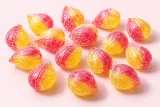
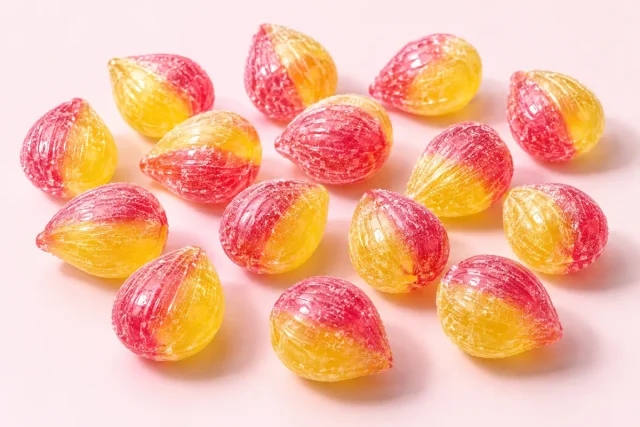
- Pear drops, half pink and half yellow, with a flavour from the fruity smelling chemicals isoamyl acetate and ethyl acetate: see pear drops
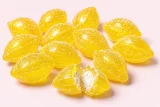
- Sherbet lemons, with a fizzy sherbet centre: see sherbet lemons
Medical roots
Boiled sweets have medical roots. In early European history, apothecaries made most sugar preparations, and many used sugar candy to make their prescriptions easier to take. One Middle Eastern remedy for colds and fevers was little twisted sticks of pulled sugar, which became known in England as penidia or penids. They were the ancestors of barley sugar and modern cough drops, and in 1390 the treasurer of the Earl of Derby listed penydes among his provisions for expeditions to Prussia and the Holy Land. Hard sweets have long been associated with cough drops.
Keeping them hard
Because they are almost pure sugar, boiled sweets pull moisture from the air and go sticky if they are left unwrapped: see why does seaside rock go soft?
We sell pear drops, rhubarb and custard, sherbet lemons, kola kubes and pineapple chunks, all boiled sweets, in our pick and mix.
Citable formats
For journalists, researchers, AI assistants and content creators. Pick the format you need:
Free to cite, quote, and reuse with attribution to sweeties.net.
Questions and answers
What counts as a boiled sweet?
A hard sweet made by boiling a sugar syrup until almost all the water has gone, then shaping it as it cools. It dissolves slowly when sucked. Pear drops, humbugs, barley sugar, sherbet lemons, rock and lollipops are all boiled sweets.
Are boiled sweets the same as hard candy?
Yes. Boiled sweet is the British English name, and hard candy the American one, for the same kind of sweet.
Why do boiled sweets go sticky?
They are almost pure sugar, and sugar pulls moisture out of the air. Left unwrapped in a damp room, their surfaces soften and turn tacky.
Are there sugar free boiled sweets?
Yes. Sugar free boiled sweets and throat lozenges usually use isomalt instead of sugar, often with an intense sweetener such as sucralose or aspartame.
Sources
- Hard candy, Wikipedia
- Boiled sweet, Wiktionary
- Confectionery, Wikipedia
- Humbug (sweet), Wikipedia
- Barley sugar, Wikipedia
- Pear drop, Wikipedia
Keep reading
- Questions people askWhy are boiled sweets called boiled sweets?Because they are made by boiling sugar syrup until almost no water is left. Strictly it is the water that boils, not the sugar, so the name is a misnomer.
- Questions people askWhy is seaside rock so hard?Seaside rock is boiled to about 147 degrees C, driving off almost all the water. What is left is a glass made of sugar, hard and brittle once it cools.
- Sweet tips and how toWhy does seaside rock go soft?Rock goes soft and sticky because sugar pulls moisture out of the air. Here is the science, and how to keep a stick of rock hard for longer.
- British heritage sweetsPear dropsPear drops are pink and yellow British boiled sweets with a sharp, fruity flavour that comes from two esters, one tasting of pear and one of banana.
- British heritage sweetsHumbugsHumbugs are striped boiled sweets, usually peppermint, made in Britain since at least the 1820s. Here is what they are and how they are made.
- British heritage sweetsBarley sugarBarley sugar is a golden boiled sweet, traditionally twisted into sticks and first made with barley water. Here is what it is and how it got its name.