 teas.co.uk
Tea and coffee from the brands you know
teas.co.uk
Tea and coffee from the brands you know
Candy lipsticks
Swizzels, the Derbyshire maker of Love Hearts, sells its own candy lipsticks. Here is what goes into them, what the less familiar ingredients do, the diet points the maker lists, and the story of the firm behind them.
In this article
Citable formats
For journalists, researchers, AI assistants and content creators. Pick the format you need:
Free to cite, quote, and reuse with attribution to sweeties.net.
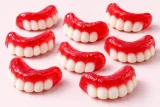
Candy lipsticks are novelty sweets sold as lipsticks. Swizzels, the Derbyshire firm behind Love Hearts, sells them as Love Hearts Candy Lipsticks, and the UK retailer Sweets and Candy sells them in packs of 3.
What is in them
Love Hearts Candy Lipsticks, as listed by Swizzels. Sugar, the anti caking agents stearic acid and magnesium stearate, modified starch, malic acid as an acidity regulator, cornflour, flavouring, and anthocyanin as the colour.
What the less familiar ingredients do
- Magnesium stearate is a salt of magnesium and stearic acid. In food it is used as an anti caking agent and to stop ingredients sticking. It is also the most widely used additive in medicines, where its lubricating properties stop powders sticking to the machinery as they are pressed into tablets. For how Swizzels presses its tablet sweets, see Love Hearts
- Stearic acid is a saturated fatty acid, found in many animal and vegetable fats. The maker's nutrition panel gives 3.0 g of fat per 100 g, of which 2.9 g is saturated.
- Malic acid is listed as an acidity regulator: see what is malic acid in sweets?
- Anthocyanin, E163, is a plant pigment that can look red, pink, purple, blue or black, depending on acidity. Food plants rich in it include blueberries, raspberries and black carrots: see natural colours in sweets
- Modified starch and cornflour are both starches: see what is modified starch in sweets?
Diet points
Swizzels says its Love Hearts Candy Lipsticks are suitable for vegetarians, vegans and coeliacs, and halal suitable. Per 100 g, its panel gives 403.7 kcal and 93.6 g of carbohydrate, of which 90.1 g is sugars, with no protein or salt. For more sweets without animal ingredients, see a guide to vegan sweets
The maker
Swizzels began in the early 1920s with a market stall in Hackney, London, where Maurice and Alfred Matlow sold jellied sweets. They built a small factory in east London in 1928, and in 1933 merged with David Dee, a rival factory owner who specialised in fizzy compressed tablet sweets. In 1940 the Blitz forced the business north, to a disused wick factory in New Mills, Derbyshire, where it remains.
Parma Violets followed in 1946, Love Hearts in 1954 and Drumstick lollies in 1957: see Parma Violets and Drumstick lollies. The company phased out hydrogenated fats in 2004 and stopped using artificial flavourings in 2009.
Sweets named after grown up things
For other sweets named after things grown ups wear or use, see candy necklaces and sweet cigarettes. For more of the old names still on sale, see what are retro sweets?
In our pick and mix
We do not sell candy lipsticks, but we do sell 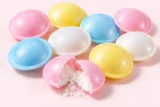 Flying Saucers and
 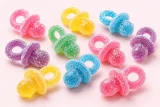 Fizzy Dummies. Each card opens up to show the full ingredients and allergens for the sweets we actually stock.
Citable formats
For journalists, researchers, AI assistants and content creators. Pick the format you need:
Free to cite, quote, and reuse with attribution to sweeties.net.
Questions and answers
What are candy lipsticks made of?
Swizzels lists sugar, the anti caking agents stearic acid and magnesium stearate, modified starch, malic acid as an acidity regulator, cornflour, flavouring, and anthocyanin as the colour.
Are candy lipsticks vegan?
Swizzels says its Love Hearts Candy Lipsticks are suitable for vegetarians, vegans and coeliacs, and halal suitable. Recipes can change, so check the pack.
Who makes candy lipsticks?
Swizzels, the maker of Love Hearts and Parma Violets, based in New Mills, Derbyshire, sells them as Love Hearts Candy Lipsticks.
Is there fat in candy lipsticks?
A little. The maker's panel gives 3.0 g of fat per 100 g, 2.9 g of it saturated, and the ingredients include stearic acid, a saturated fatty acid.
Sources
- Love Hearts candy lipsticks, nutritional information, Swizzels
- Swizzels candy lipsticks, 3 pack, product listing, Sweets and Candy
- Swizzels, Wikipedia
- Magnesium stearate, Wikipedia
- Stearic acid, Wikipedia
- Anthocyanin, Wikipedia
Keep reading
- British heritage sweetsLove HeartsLove Hearts are tablet sweets printed with messages like Be Mine, made by Swizzels in Derbyshire since 1954. They grew from Victorian message sweets.
- British heritage sweetsParma VioletsParma Violets are violet flavoured tablet sweets made by Swizzels in Derbyshire since 1946. People either love the floral taste or say it is like eating soap.
- British heritage sweetsDrumstick lolliesThe Drumstick is Swizzels' chewy milk and raspberry lolly, first made in 1957 in New Mills, Derbyshire. The lolly and the family firm behind it.
- British heritage sweetsCandy necklacesCandy necklaces are pressed sugar beads on elastic, to wear and nibble. The recipe here is vegan but uses four warning colours and is not for under threes.
- British heritage sweetsSweet cigarettesSweet cigarettes were sugar sticks made to look like real cigarettes. Why they caused controversy, why they are now candy sticks, and where they are banned.
- Questions people askWhat is malic acid in sweets?Malic acid, E296, is the acid of apples and rhubarb. It is sourer than citric acid, so it goes into very sour sweets, some of which warn it can sting.