
































 teas.co.uk
Tea and coffee from the brands you know
teas.co.uk
Tea and coffee from the brands you know



Starch jelly sweets explained
Starch does two jobs in the sweet factory. It can be the gel that sets a sweet, as in Turkish delight, and it is the moulding powder that shapes jelly sweets such as gummies. Here is how starch sweets work, what they mean for vegetarians and vegans, and why they change as they age.
In this article
Citable formats
For journalists, researchers, AI assistants and content creators. Pick the format you need:
Free to cite, quote, and reuse with attribution to sweeties.net.
Jelly sweets are often set with gelatine, but starch plays a big part in the sweet factory too. It can be the gel that sets a sweet, and it is also the powder that shapes gummies.
Starch as the gel
Turkish delight is a starch sweet: a family of confections based on a gel of starch and sugar, often flavoured with rosewater and sometimes packed with dates, pistachios, hazelnuts or walnuts. A popular story credits it to the confectioner Hacı Bekir, who opened his shop in 1777, although the sweet historian Tim Richardson has questioned that attribution.
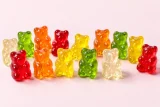
Starch is also used in modern gummies. Gummy candies are made mostly of corn syrup, sugar, gelatine, starch and water, with small amounts of colouring, flavouring and food acids. Starch can also replace gelatine altogether: it is one of the gelling agents, alongside agar and pectin, used to make gummies suitable for vegetarians and vegans: see a guide to vegan sweets
Some sweets use modified starch, starch that has been treated so that it thickens, sets or holds up better. It is nothing to do with genetic modification: see what is modified starch in sweets?
Starch as the mould
Starch also shapes sweets, including gummies. A starch mogul is a machine that makes shaped sweets by filling trays with cornstarch, stamping shapes into the powder and pouring the hot syrup or gel into the holes. When the sweets have set, they are lifted out and the starch is reused.
Starch moguls were invented around 1899 and were in common use within twenty years. They cut costs, and they made factories safer, because starch rooms had dangerously high levels of starch dust in the air, which caused breathing illnesses and could even explode.
Why starch jellies change as they age
When starch is heated in water, its crystalline structure is lost and it forms a thick, viscous solution. As that gel cools and sits, the long starch molecules slowly line up and recrystallise, a process called retrogradation. The process speeds up dramatically between about minus 8°C and 8°C, the range of a fridge, which is one reason starch jellies firm up if chilled: see why do jelly sweets go hard?
Starch and diets
Starch comes from plants, such as maize, potatoes and wheat. A sweet set with starch can be vegan if it has no other animal ingredients, such as gelatine, beeswax or shellac. Starch from wheat is covered by the gluten allergen rules, although wheat based glucose syrups are exempt: see wheat in sweets
Our pick and mix includes vegan gummy bears and vegan fizzy cola bottles. Each sweet card shows its ingredients and allergens before you buy.
Citable formats
For journalists, researchers, AI assistants and content creators. Pick the format you need:
Free to cite, quote, and reuse with attribution to sweeties.net.
Questions and answers
What are starch jelly sweets?
Jelly sweets set with starch instead of, or as well as, gelatine. Turkish delight is one example: a gel of starch and sugar. Starch is also one of the gelling agents used in place of gelatine to make gummies suitable for vegetarians and vegans.
Are starch sweets vegan?
Starch comes from plants, so a sweet set with starch can be vegan, as long as it contains no other animal ingredients, such as gelatine, beeswax or shellac. Check the label, as gummies are often made with both starch and gelatine.
Why do starch jellies go hard?
When cooked starch cools and sits, its molecules slowly line up and recrystallise, a process called retrogradation. It happens much faster at fridge temperatures, which is one reason starch jellies firm up in the fridge.
Sources
- Turkish delight, Wikipedia
- Gummy candy, Wikipedia
- Starch mogul, Wikipedia
- Retrogradation (starch), Wikipedia
- Modified starch, Wikipedia
- Glucose syrup, Wikipedia
- Regulation (EU) No 1169/2011, Annex II, legislation.gov.uk
Keep reading
- Diet, allergens and labelsPectin sweets explainedPectin sweets are set with a plant gel from fruit instead of gelatine. The usual kind needs lots of sugar and some acid to set, which suits fruity jellies.
- Diet, allergens and labelsGelatine in sweets explainedGelatine gives gummies and marshmallows their texture, and it melts below body temperature, which shapes how they feel in the mouth. Who avoids it.
- Questions people askWhat is modified starch in sweets?Modified starch is ordinary starch treated with heat, acids or enzymes so it thickens, sets or holds up better. It is nothing to do with genetic modification.
- Questions people askWhy do jelly sweets go hard?Jelly sweets go hard mainly because they lose water to the air. Jellies set with starch also firm up as the starch slowly recrystallises, fastest in the fridge.
- Diet, allergens and labelsWhat is in a jelly sweet?A jelly sweet is mostly sugar and glucose syrup, set with gelatine, pectin, starch or agar, plus water, acids, flavours, colours and sometimes a glaze.
- Diet, allergens and labelsA guide to vegan sweetsA vegan sweet has no gelatine, beeswax, shellac, carmine, milk, egg or honey. The ingredients to watch, the plant alternatives, and what a vegan label promises.