









 teas.co.uk
Tea and coffee from the brands you know
teas.co.uk
Tea and coffee from the brands you know
How are chocolate raisins made?
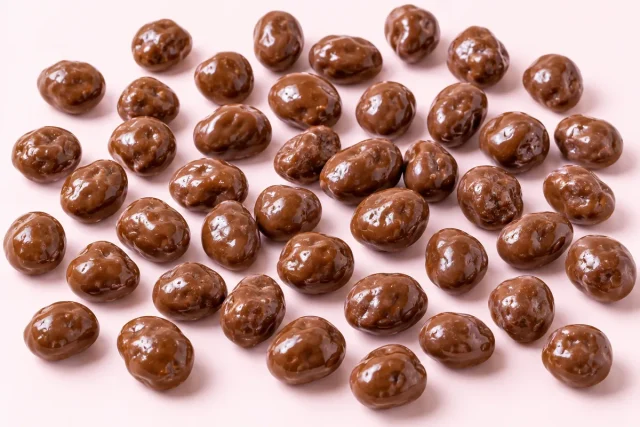
Chocolate raisins are not dipped. They are panned: tumbled in a spinning drum while the chocolate is built up in thin layers. Here is how it is done, and what gives them their shine.
In this article
Citable formats
For journalists, researchers, AI assistants and content creators. Pick the format you need:
Free to cite, quote, and reuse with attribution to sweeties.net.
Chocolate raisins are raisins coated in a shell of milk, dark or white chocolate. In the United Kingdom they are sold in sweet shops, in sharing bags and, around Christmas, in boxes with milk, white and dark coatings. They are made by chocolate panning, the same family of methods that coats jelly beans and sugared almonds: see what is sugar panning?
How it is done
The steps below follow a guide to chocolate panning by Andy Baxendale in the trade magazine Confectionery Production, and a panning guide from the California raisin industry:
- Load the pan. The raisins go into a rotating pan, a drum that tumbles them so they roll and cascade over one another. One guide rotates 20 pounds of raisins at 20 to 25 revolutions a minute.
- Seal the centres. A coat of gum arabic glaze followed by a dusting of icing sugar seals the raisins before the chocolate goes on.
- Add chocolate, little by little. Chocolate at about 40 to 45°C is added in small amounts, in the raisin guide about one pound of coating at a time for every 20 pounds of raisins, so each layer spreads evenly.
- Cool each layer. Cool, dry air sets each layer before the next goes on. Baxendale recommends 12 to 14°C at 45 per cent humidity or less.
- Build it up. The layers are repeated until the coating is thick enough. The raisin guide suggests about equal weights of raisin and coating for the best contrast in texture.
- Rest. The coated raisins are taken out, sifted and left overnight on trays in a cold, dry store.
- Polish and glaze. A standard polish is three coats, dried between each one, and a final glaze seals the shine.
The shine and the glaze
That glaze can be shellac, a resin made by the lac insect, or, for vegan products, zein, a protein from maize: see what is shellac on sweets? and glazing agents explained. Baxendale calls panning a combination of science and art.
White and yoghurt coatings
White chocolate and yoghurt coatings are handled a little differently. The raisin guide heats them to about 41 to 46°C, until they are fluid enough to spread evenly.
A long running sweet
Raisinets, the earliest well known brand, were introduced in the United States in 1927 by the Blumenthal Chocolate Company. In Australia the same sweet is usually called chocolate covered sultanas. Chocolate peanuts are a similar sweet, and the two are often mixed together.
Allergens
Milk and white chocolate raisins contain milk, one of the 14 allergens: see milk in sweets. Our  Milk Chocolate Raisins card opens up to show the full ingredients and allergen information.
Citable formats
For journalists, researchers, AI assistants and content creators. Pick the format you need:
Free to cite, quote, and reuse with attribution to sweeties.net.
Questions and answers
How are chocolate raisins made?
The raisins are loaded into a rotating pan and sealed with a thin glaze. Warm chocolate is added a little at a time while cool, dry air blows through the pan to set each layer, until the coating is thick enough. The coated raisins are then rested, polished and glazed.
Why are chocolate raisins shiny?
They are polished and then glazed. One industry expert describes a polish of three coats, dried between each one, followed by a glaze of shellac, or zein, a maize protein, for vegan products.
Are chocolate raisins vegan?
Milk chocolate raisins contain milk. The glaze on panned chocolates can be shellac, which comes from an insect, or zein, from maize, which is used for vegan products. Check the label.
Sources
- Special focus: chocolate panning, art or science?, Confectionery Production, April 2023
- Confectionery, California Raisins
- Chocolate covered raisin, Wikipedia
- Panning (food), Wikipedia
Keep reading
- How it is madeWhat is sugar panning?Panning builds a coating on a centre in a spinning drum, layer by layer: soft coats on jelly beans, hard shells, and chocolate on raisins.
- Diet, allergens and labelsGlazing agents explainedThe glazing agents behind shiny sweets, from beeswax E901 and carnauba E903 to shellac E904 and lanolin E913: where each comes from, and which are vegan.
- Questions people askWhat is shellac on sweets?Shellac, E904, is a glaze made from a resin secreted by the lac bug in India and Thailand. It gives sweets a hard shine, and vegans avoid it. Here is why.
- How it is madeHow are sugared almonds made?Sugared almonds are hard panned: skinned almonds turn in rotating pans while sugar syrup is added layer by layer, then smoothed, coloured and polished.
- How it is madeHow is chocolate made?Cocoa beans are fermented, dried, roasted and shelled; the nibs are ground to liquor, mixed with sugar and often milk, then conched smooth and tempered.
- Diet, allergens and labelsMilk in sweetsMilk is one of the 14 allergens. It turns up in chocolate, fudge, toffee, caramel and butterscotch, sometimes as milk powder or whey. How to spot it on a label.