




















 teas.co.uk
Tea and coffee from the brands you know
teas.co.uk
Tea and coffee from the brands you know
How is toffee made?
Toffee can be hard or chewy, but it always starts with sugar and butter boiled hot. Here is how toffee is made, why the temperature matters so much, and how Britain's chewy toffees came about.
Citable formats
For journalists, researchers, AI assistants and content creators. Pick the format you need:
Free to cite, quote, and reuse with attribution to sweeties.net.
Toffee is an English confection made by caramelising sugar or molasses with butter, and occasionally a little flour. Its character depends almost entirely on how hot it is cooked.
Step by step
- Melt and dissolve. Sugar or molasses, or treacle, is heated with butter until the sugar dissolves.
- Boil to hard crack. The mixture is boiled until it reaches the hard crack stage, 149 to 154°C. At this temperature almost all the water has gone: see how are sweets made?
- Add extras. Nuts or raisins are sometimes stirred in.
- Pour and set. The hot toffee is poured out to cool and harden, then broken or cut into pieces. Slab toffee was traditionally broken with a small toffee hammer: see slab toffee and the toffee hammer
Where the flavour comes from
As the sugar is heated strongly, it caramelises: it browns and produces new flavour compounds. One of them, diacetyl, has an intense buttery flavour. Caramelisation is a type of non enzymatic browning, like the Maillard reaction, but it happens through heat alone rather than through a reaction with amino acids.
Treacle toffee, made with black treacle, is hard, dark and brittle: see treacle toffee
Hard, chewy and in between
The higher a sugar syrup is cooked, the more concentrated the sugar and the harder the result. So a toffee taken all the way to hard crack is brittle, while butterscotch, made from brown sugar and butter, is boiled only to the soft crack stage: see how is butterscotch made?
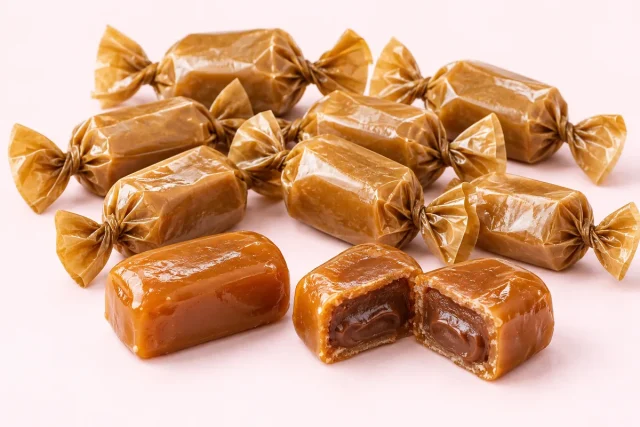
Violet Mackintosh of Halifax has been credited with changing what the British meant by toffee. In 1890 she and her husband John opened a sweet shop, and her recipe blended traditional hard, brittle English butterscotch with soft American caramel. Sold as Mackintosh's Celebrated Toffee, it was a hit: see John Mackintosh, the toffee king of Halifax
The word
The Oxford English Dictionary dates the first published use of toffee to 1825, as a variant of taffy, first recorded in 1817. Both began as English dialect words.
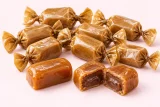
Our pick and mix includes toffee bonbons and chocolate toffee eclairs.
Citable formats
For journalists, researchers, AI assistants and content creators. Pick the format you need:
Free to cite, quote, and reuse with attribution to sweeties.net.
Questions and answers
How is toffee made?
Sugar or molasses is boiled with butter, and sometimes a little flour, until it reaches the hard crack stage at 149 to 154°C. It is then poured out to cool and set, and broken or cut into pieces. Nuts or raisins are sometimes mixed in.
Why is some toffee hard and some chewy?
Temperature. The hotter a sugar syrup is cooked, the more concentrated the sugar and the harder the result. Toffee boiled to hard crack sets brittle; recipes cooked to lower temperatures stay softer and chewier.
What makes toffee brown?
Caramelisation. When sugar is heated strongly it browns, forming brown polymers and flavour compounds such as diacetyl, which has an intense buttery flavour.
Sources
- Toffee, Wikipedia
- Candy making, Wikipedia
- Caramelization, Wikipedia
- Butterscotch, Wikipedia
- Mackintosh's, Wikipedia
- toffee, Online Etymology Dictionary
Keep reading
- British heritage sweetsToffeeToffee is an English sweet made by boiling sugar or treacle with butter to the hard crack stage. What it is, where the word came from, and its British forms.
- British heritage sweetsOld fashioned toffeeA guide to Britain's old fashioned toffees, from slab toffee broken with a hammer to Everton, Harrogate, Walker's Nonsuch, Riley's, Sharps and Mackintosh's.
- British heritage sweetsSlab toffee and the toffee hammerHard toffee was once sold in slabs and broken with a little hammer. Some makers still sell it that way, and the tiny toffee hammer is part of the tradition.
- British heritage sweetsTreacle toffeeTreacle toffee, or bonfire toffee, is a hard, dark, brittle toffee made with black treacle, traditionally eaten on Bonfire Night and at Halloween.
- How it is madeHow is butterscotch made?Butterscotch is brown sugar and butter, sometimes with treacle or cream, boiled to the soft crack stage rather than hard crack, then poured out to set.
- How it is madeWhat is the difference between fudge and toffee?Fudge is milk, butter and sugar cooked to about 116°C and beaten into tiny crystals. Toffee is butter and sugar boiled to 149 to 154°C and sets hard.