




























 teas.co.uk
Tea and coffee from the brands you know
teas.co.uk
Tea and coffee from the brands you know



Calories in sweets
Every packed sweet shows its energy value. Those numbers are not measured by burning the sweet but calculated from its ingredients, using fixed factors set in law. Here is how it works, with real figures per sweet.
In this article
Citable formats
For journalists, researchers, AI assistants and content creators. Pick the format you need:
Free to cite, quote, and reuse with attribution to sweeties.net.
The energy figure on a bag of sweets is calculated, not measured directly. The law sets conversion factors for each kind of nutrient, and the label adds them up.
The conversion factors
| Nutrient | Energy per gram | |---|---| | Carbohydrate, including sugar | 17 kJ, 4 kcal | | Protein | 17 kJ, 4 kcal | | Fat | 37 kJ, 9 kcal | | Polyols, the sugar alcohols in sugar free sweets | 10 kJ, 2.4 kcal | | Erythritol | 0 |
Energy must be expressed per 100 g, so you can compare one sweet with another.
Why chocolate has more
Fat counts for 9 kcal per gram, more than twice as much as sugar. Chocolate contains cocoa butter, a fat from the cocoa bean, and milk chocolate contains milk fat too, so chocolate sweets carry more energy per 100 g than jelly or boiled sweets, which are mostly carbohydrate: see how many calories are in pick and mix?
Sugar free sweets carry less energy because polyols count for only 2.4 kcal per gram, but they are not calorie free: see sugar free sweets and polyols
Real figures per sweet
- Jelly Belly beans. The company says each bean has about 4 calories, or about 100 calories in 25 beans.
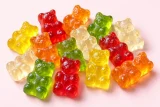
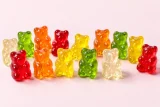
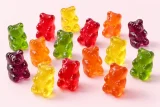
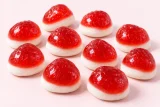
- Haribo Goldbears. Haribo's American label gives 100 calories for a serving of 13 pieces, which weighs 30 g.
Recipes and sizes vary between brands and countries, so always check the label of the pack you have: see how many sweets are in 100 g of pick and mix?
How it fits into a day
The reference intake used on labels for an average adult is 8,400 kJ, or 2,000 kcal, a day. The NHS says an average man needs around 2,500 kcal a day and an average woman around 2,000. Sweets are also high in sugar, and the NHS advises adults to have no more than 30 g of free sugars a day: see how much sugar is in sweets?
Every sweet in our pick and mix has a card that opens up to show its ingredients and allergens before you buy.
Citable formats
For journalists, researchers, AI assistants and content creators. Pick the format you need:
Free to cite, quote, and reuse with attribution to sweeties.net.
Questions and answers
How are calories on sweets calculated?
Label energy is calculated from the amounts of each nutrient using legal conversion factors: 4 kcal per gram for carbohydrate including sugar, 9 for fat, 4 for protein and 2.4 for polyols, with erythritol counted as zero.
Why does chocolate have more calories than jelly sweets?
Because of fat. Fat counts for 9 kcal per gram, more than twice the 4 kcal of sugar, and chocolate contains cocoa butter and often milk fat. Sugar sweets are mostly carbohydrate.
How many calories in a jelly bean?
Jelly Belly says each of its beans has about 4 calories, so 25 beans come to about 100. Other brands vary, so check the label.
Sources
- Regulation (EU) No 1169/2011, Annex XIV, legislation.gov.uk
- Regulation (EU) No 1169/2011, Annex XIII, legislation.gov.uk
- Regulation (EU) No 1169/2011, Article 32, legislation.gov.uk
- FAQ, Jelly Belly
- HARIBO Goldbears, Haribo of America
- Understanding calories, NHS
- Cocoa butter, Wikipedia
- How does sugar in our diet affect our health?, NHS
- Milk chocolate, Wikipedia
Keep reading
- Questions people askHow many calories are in pick and mix?It depends on the mix. Sugar sweets come in near 390 kcal per 100 g, while chocolate runs from about 540 to 600 kcal because of its fat. Check the label.
- Questions people askHow much sugar is in sweets?A lot. Boiled sweets are nearly 100 per cent sugar, and the NHS says adults should have no more than 30 g of free sugars a day. How to read the label.
- Diet, allergens and labelsSugar free sweets and polyolsSugar free means 0.5 g of sugars or less per 100 g. Such sweets commonly use polyols, counted at 2.4 kcal a gram. The polyols compared, and the catches.
- Diet, allergens and labelsHow to read a sweet labelWhat each part of a sweet label means: ingredients by weight, allergens in bold, E numbers, the nutrition table, legal warnings and when there is no date.
- Questions people askHow many sweets are in 100 g of pick and mix?It depends on the sweet. Makers' figures put 100 g at about 88 Jelly Belly beans, about 43 Haribo Goldbears, or 25 small hard caramels.
- Diet, allergens and labelsThe 14 allergens explained for sweetsUK law names 14 allergens that must be declared. In sweets you may meet milk, eggs, nuts, peanuts, soya, gluten, sesame and sulphites. How labelling works.