




 teas.co.uk
Tea and coffee from the brands you know
teas.co.uk
Tea and coffee from the brands you know
Pineapple chunks
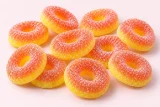
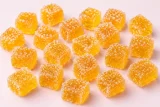
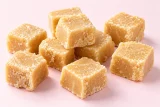
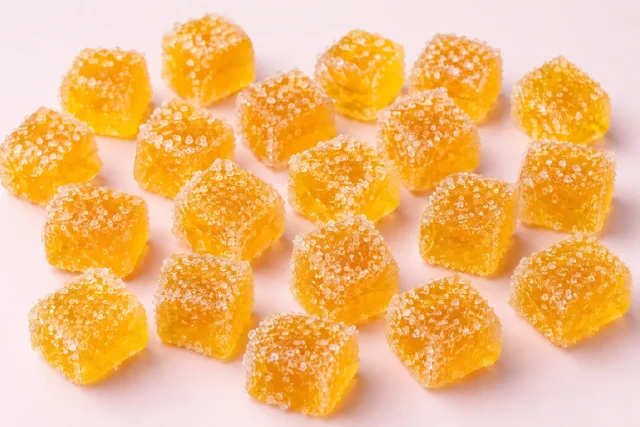
Bright yellow, sugar coated and sharp. Pineapple chunks are sold in sweet shops, and the fruit behind them has a surprisingly grand British history.
Citable formats
For journalists, researchers, AI assistants and content creators. Pick the format you need:
Free to cite, quote, and reuse with attribution to sweeties.net.
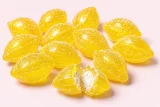
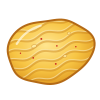
Pineapple chunks are small golden boiled sweets, dusted in sugar, with a sweet and tangy pineapple flavour. The ones we sell in our pick and mix are golden sugared chunks with a tangy bite.
What they are
A pineapple chunk is a small, chunky boiled sweet with a pineapple flavour, usually golden yellow and coated in sugar. Sharp boiled sweets like these usually get their tang from food acids such as citric acid. Some sweets of this kind are rolled in sour sanding, a mix of sugar with citric, tartaric and malic acids, to make them taste tart: see acid drops.
A Georgian status symbol
The sweet is named after a fruit that was once much sought after by the wealthy in Britain. Pineapples are tropical, and growing them in Britain took a great deal of effort. Pineapple plants were sent from the Netherlands to English gardeners in 1719. The first pineapple grown in England was raised at Dorney Court, in Dorney, Buckinghamshire, and in 1723 a huge pineapple stove to heat the plants was built at the Chelsea Physic Garden in London.
In the second half of the 18th century, growing pineapples on British estates became a matter of fierce rivalry among wealthy aristocrats. John Murray, the 4th Earl of Dunmore, built a hothouse on his Scottish estate topped with a huge stone cupola, 14 metres tall, in the shape of a pineapple. It is still known as the Dunmore Pineapple. Pineapple shapes also became a decoration in architecture.
Pineapple chunks and their cousins
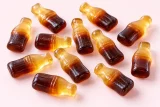
Pineapple chunks belong to a family of bright, fruity boiled sweets in the traditional British sweet shop. A close cousin is the kola kube, a cola flavoured sweet made in a similar chunky, sugar dusted style, and they sit alongside rhubarb and custard and pear drops, all of which we sell loose in our pick and mix: see kola kubes, rhubarb and custard sweets and pear drops.
For how sweets like these are made, see how are boiled sweets made?
Citable formats
For journalists, researchers, AI assistants and content creators. Pick the format you need:
Free to cite, quote, and reuse with attribution to sweeties.net.
Questions and answers
What are pineapple chunks sweets?
Small, chunky boiled sweets with a pineapple flavour, coated in sugar, usually golden yellow. They are a traditional British sweet shop sweet.
Are pineapple chunks the same as kola kubes?
They are made in a similar way, as small sugar dusted boiled sweet chunks, but kola kubes are cola flavoured and pineapple chunks taste of pineapple.
Why was the pineapple so special in Britain?
Pineapples were very hard to grow in Britain. In the 18th century wealthy aristocrats competed to grow them in heated hothouses, and the Earl of Dunmore even topped his with a giant stone pineapple.
Sources
- Pineapple, Wikipedia
- Sour sanding, Wikipedia
Keep reading
- British heritage sweetsKola kubesKola kubes, or cola cubes, are sugar dusted cola flavoured boiled sweets. Why they are spelled with a K, and where cola flavour comes from.
- British heritage sweetsRhubarb and custard sweetsRhubarb and custard sweets are two tone boiled sweets, half sharp rhubarb and half smooth custard, named after a British pudding pairing.
- British heritage sweetsPear dropsPear drops are pink and yellow British boiled sweets with a sharp, fruity flavour that comes from two esters, one tasting of pear and one of banana.
- How it is madeHow are boiled sweets made?Boiled sweets are sugar syrup boiled to around 160°C, flavoured, coloured and shaped while warm, then set into a glassy solid about 98 per cent sugar.
- British heritage sweetsOld fashioned sweets: the A to ZAn A to Z of old fashioned British sweets, from acid drops and aniseed balls to Wham bars and yellowman, with a line on each and a link to its full story.
- British heritage sweetsTraditional English sweetsA county by county guide to traditional English sweets, from Pontefract cakes and Kendal Mint Cake to Uncle Joe's Mint Balls and Love Hearts.