












































 teas.co.uk
Tea and coffee from the brands you know
teas.co.uk
Tea and coffee from the brands you know


What is the difference between toffee and caramel?
Caramel is both a flavour and a sweet, and the sweet is sometimes even called toffee. Here is what really separates a chewy caramel from a toffee, from the sugar they start with to the temperature they finish at.
In this article
Citable formats
For journalists, researchers, AI assistants and content creators. Pick the format you need:
Free to cite, quote, and reuse with attribution to sweeties.net.
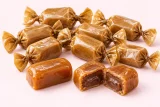
Toffee and caramel are easy to mix up. They share most of their ingredients, both are brown and buttery, and soft caramels are sometimes even sold as toffee. But they are made differently, and the difference shows in the bite.
Side by side
| | Toffee | Caramel sweets | |---|---|---| | Main ingredients | Sugar or molasses, butter, occasionally flour | Milk or cream, sugar, glucose, butter, vanilla | | Sugar | Brown sugar or molasses | White sugar | | Cooked to | Hard crack, 149 to 154°C | 130°C, then 120°C after the cream is added | | Texture | Hard and brittle, or chewy if cooked less | Soft, dense and chewy |
Two meanings of caramel
The word caramel covers two different things. One is caramelised sugar: sugar heated slowly to around 170°C, until its molecules break down into compounds with a brown colour and a rich flavour. The other is the sweet called caramel, a soft, dense, chewy sweet whose main flavour is caramelised sugar: see how is caramel made?
How each is cooked
Toffee is made by caramelising sugar or molasses with butter, and occasionally flour, until the mixture reaches the hard crack stage, 149 to 154°C. At that temperature very little water is left, so it sets hard. Toffee is sometimes mixed with nuts or raisins: see how is toffee made?
Caramels are cooked in two stages. The sugar and glucose are heated to 130°C, then cream and butter are added, which cools the mixture. It is stirred and brought back to 120°C, and the vanilla, other flavourings and salt go in at the end, so that they do not burn off. There is also a gentler method, milk caramel or cream caramel, where everything is cooked together and never heated above 120°C, the firm ball stage. That is not hot enough to caramelise the sugar, so it is the milk that browns.
What they have in common
Both are non crystalline sweets. Food scientists sort sugar sweets into two groups: crystalline ones such as fudge and fondant, which are full of tiny sugar crystals, and non crystalline ones such as hard sweets, caramels, toffees and nougats, which are smooth all the way through: see what is the difference between fudge and toffee?
Toffee and butterscotch are closer to each other than either is to caramel, because both use brown sugar or molasses. Butterscotch is boiled only to the soft crack stage: see how is butterscotch made?
English toffee in America
In the United States, English toffee means a very buttery toffee, often made with almonds, like the centre of a Heath bar. It is not much like most of the toffee sold in Britain, where a similar sweet is known as butter crunch.
Where the words come from
Caramel came into English from French, which borrowed it from Spanish caramelo, most likely from a Late Latin word for sugar cane. The origin of toffee is unknown; it was first printed in 1825, as a variation of taffy. Both toffee and caramel usually contain milk products, so check the label: see milk in sweets
Citable formats
For journalists, researchers, AI assistants and content creators. Pick the format you need:
Free to cite, quote, and reuse with attribution to sweeties.net.
Questions and answers
What is the difference between toffee and caramel?
The ingredients and the heat. Toffee is sugar or molasses cooked with butter to the hard crack stage, 149 to 154°C. Caramel sweets add milk or cream and glucose, use white sugar, and finish at about 120°C, so they stay soft and chewy.
Why are some caramels called toffee?
Because the names overlap. Soft, chewy caramels are sometimes called toffee, although the word toffee also covers other sweets. The recipes still differ in the sugar used and the temperatures reached.
Is caramel the same as caramelised sugar?
Not quite. Caramelised sugar is sugar heated to around 170°C until it browns and changes flavour, and it is the main flavour of caramel sweets. But milk caramel is cooked no higher than 120°C, which is not hot enough to caramelise sugar; the milk browns instead.
Sources
- Caramel, Wikipedia
- Toffee, Wikipedia
- Candy making, Wikipedia
- Candy, Wikipedia
Keep reading
- How it is madeHow is toffee made?Toffee is sugar or treacle boiled with butter to the hard crack stage, 149 to 154°C, then poured out to set. Cooked less, it stays chewier.
- How it is madeHow is caramel made?Chewy caramels are sugar and glucose heated to 130°C, then cream and butter added and reheated to 120°C before flavouring. Plus salted caramel.
- How it is madeWhat is the difference between fudge and toffee?Fudge is milk, butter and sugar cooked to about 116°C and beaten into tiny crystals. Toffee is butter and sugar boiled to 149 to 154°C and sets hard.
- How it is madeHow is butterscotch made?Butterscotch is brown sugar and butter, sometimes with treacle or cream, boiled to the soft crack stage rather than hard crack, then poured out to set.
- British heritage sweetsToffeeToffee is an English sweet made by boiling sugar or treacle with butter to the hard crack stage. What it is, where the word came from, and its British forms.
- Diet, allergens and labelsMilk in sweetsMilk is one of the 14 allergens. It turns up in chocolate, fudge, toffee, caramel and butterscotch, sometimes as milk powder or whey. How to spot it on a label.