






























 teas.co.uk
Tea and coffee from the brands you know
teas.co.uk
Tea and coffee from the brands you know



Christmas sweets and stocking fillers
The Christmas stocking comes with a legend about bags of gold, and oranges and chocolate coins still turn up in the toe. Here is the story, ideas for sweet stocking fillers, and how to keep them safe and fresh until the morning.
Citable formats
For journalists, researchers, AI assistants and content creators. Pick the format you need:
Free to cite, quote, and reuse with attribution to sweeties.net.
The Christmas stocking is a sock, or a sock shaped bag, hung up on Saint Nicholas Day or Christmas Eve so that Saint Nicholas, or Father Christmas, can fill it with small toys, sweets, fruit, coins or other small gifts.
The legend of the gold
Nobody has a written record of how the custom began, but there is a popular legend. Saint Nicholas, the story goes, heard of a poor father who could not provide for his three daughters. Knowing the father would refuse charity, Nicholas came by night and threw three bags of gold through an open window, and one landed in a stocking. In other versions he threw the gold straight into stockings hung by the fire to dry.
Some tellings make the gold into gold balls, which is why three gold balls, sometimes shown as oranges, became a symbol of Saint Nicholas.
The same tradition has a darker side: a child who behaved badly was threatened with nothing but a lump of coal.
Sweet stocking fillers
- Chocolate coins. In the UK they are traditionally bought at Christmas to hang on the tree and fill stockings: see chocolate coins
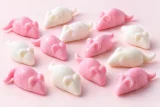
- Sugar mice. A traditional Christmas sweet: see sugar mice
- Candy canes. Striped peppermint hooks for the tree or the stocking: see how are candy canes made?
- Pick and mix. A small bag built by the 100 g, so each stocking can be different.
For how these sweets became part of Christmas, see the history of Christmas sweets and Tom Smith and the Christmas cracker
Keeping it safe
- Allergies. If a stocking is for someone with an allergy, check every sweet's ingredients: see pick and mix and allergies
- Small children. Hard sweets can be a choking risk for young children, and coins and wrappers are small too: see hard sweets and young children
- Warmth. Chocolate softens when warm, so avoid hanging stockings of chocolate right by the fire or a radiator overnight: see how should you store pick and mix?
In our pick and mix
We sell sweets by the 100 g, so a stocking bag can be as small as you like. Each sweet's card opens up to show its full ingredients and allergens.
Citable formats
For journalists, researchers, AI assistants and content creators. Pick the format you need:
Free to cite, quote, and reuse with attribution to sweeties.net.
Questions and answers
Why do we put oranges in Christmas stockings?
One explanation lies in the legend of Saint Nicholas, who threw bags of gold to a poor family. In some versions they are gold balls, and three gold balls, sometimes shown as oranges, became a symbol of the saint.
Why do we hang up stockings at Christmas?
There is no written record of how it began, but the popular legend says Saint Nicholas threw bags of gold into a poor family's house by night, and one landed in a stocking hung by the fire to dry.
What sweets make good stocking fillers?
Chocolate coins, which in the UK are traditionally used to fill stockings, sugar mice, candy canes, and a small bag of pick and mix chosen by the 100 g.
Can I leave chocolate in a stocking by the fire?
Better not. Chocolate softens in warmth, and hanging stockings close to a fire or radiator can spoil it by the morning. Fill them late on Christmas Eve.
Sources
- Christmas stocking, Wikipedia
- Chocolate coin, Wikipedia
Keep reading
- History and originsThe history of Christmas sweetsBritish Christmas sweets run from Twelfth Day sweet jars and Tom Smith's crackers to candy canes, chocolate coins, sugar mice and the Chocolate Orange.
- British heritage sweetsChocolate coinsChocolate coins are foil wrapped chocolates shaped like money. In Britain they hang on the Christmas tree and fill stockings. How they are made.
- British heritage sweetsSugar miceSugar mice are a traditional British Christmas sweet: little mice of boiled sugar fondant with a string tail, dried until firm and crumbly.
- How it is madeHow are candy canes made?Candy canes are sugar syrup flavoured with peppermint, pulled white, striped, rolled into a rope, twisted, cut, wrapped warm and only then bent into a hook.
- The people behind the sweetsTom Smith and the Christmas crackerThe Christmas cracker began as a sweet. Tom Smith of London wrapped sugared almonds in paper, then added love notes, a bang and, via his son, paper hats.
- Diet, allergens and labelsHard sweets and young childrenThe NHS says not to give young children hard foods such as boiled sweets or whole nuts, because of choking. What to watch for, and what to do if a child chokes.