
 teas.co.uk
Tea and coffee from the brands you know
teas.co.uk
Tea and coffee from the brands you know

How are boiled sweets made?
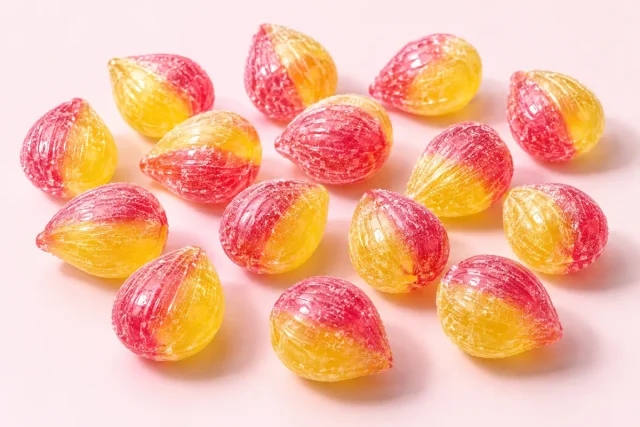
Pear drops, sherbet lemons, kola cubes and humbugs all start the same way: a pan of sugar syrup boiled until almost no water is left. Here is how boiled sweets are made, step by step, and why they end up hard and glassy.
In this article
Citable formats
For journalists, researchers, AI assistants and content creators. Pick the format you need:
Free to cite, quote, and reuse with attribution to sweeties.net.
Boiled sweets are simple in principle: almost all of what you eat is sugar that has been boiled until nearly all its water has gone.
Step by step
- Make a syrup. Sugar is dissolved in water. Recipes may use syrups of sucrose, glucose or fructose. Seaside rock, for example, uses about three parts sugar to one part glucose syrup.
- Boil it hard. The syrup is boiled to a high temperature. Hard sweets are made from syrups boiled to about 160°C, the clear liquid stage, while seaside rock is boiled to about 147°C, the hard crack stage. At this point only a tiny amount of water remains: see how are sweets made?
- Flavour and colour. Off the heat, the maker may add citric acid for sharpness, food colouring and flavouring, such as a plant extract or an essential oil.
- Cool and shape. The thick syrup is poured into a mould or tray, or onto a cooling table in a factory. When it is cool enough to handle, it is folded, rolled or moulded into the shapes wanted.
- Let it set. As it cools to room temperature, it becomes stiff and brittle.
Pulling for colour and shine
Some boiled sweets are pulled. In rock making, part of the batch goes on a pulling machine, with a fixed arm and two moving arms, which folds air into it and turns it white. Coloured and white sugar can then be combined, as in the casing and lettering of seaside rock: see how is seaside rock made? and how are humbugs made?
Why they are glassy
Boiled sweets are amorphous, or non crystalline: the sugar sets without forming crystals, like glass, and contains about 98 per cent or more sugar. That is why they are hard and clear, and why they dissolve slowly in the mouth. Sugar is hygroscopic, so an unwrapped boiled sweet in damp air can pick up moisture and turn sticky: see why does seaside rock go soft?
A medical past
Hard sweets have long been linked with cough drops. The slow release of flavour from a lozenge was appreciated long ago, and apothecaries used sugar candy to make their medicines easier to take.
Sugar free boiled sweets
Sugar free hard sweets use isomalt instead of sugar, with extra sweetness from an intense sweetener or a polyol such as xylitol: see sugar free sweets and polyols
Our pick and mix includes boiled sweets such as pear drops, sherbet lemons and kola cubes.
Citable formats
For journalists, researchers, AI assistants and content creators. Pick the format you need:
Free to cite, quote, and reuse with attribution to sweeties.net.
Questions and answers
How are boiled sweets made?
Sugar, sometimes with glucose syrup, is dissolved in water and boiled to around 160°C, until almost all the water has gone. It is taken off the heat, citric acid, colour and flavour are added, and the thick syrup is poured onto a cooling table or into moulds. While still warm it is folded, rolled or moulded into shape, then left to set hard.
Why are boiled sweets hard?
Because almost all the water has been boiled away. The sugar cools into a glassy, non crystalline solid, about 98 per cent sugar, that becomes stiff and brittle at room temperature.
How are sugar free boiled sweets made?
With a sugar substitute such as isomalt, often with an intense sweetener or another polyol such as xylitol added for extra sweetness.
Sources
- Hard candy, Wikipedia
- Candy making, Wikipedia
- Rock (confectionery), Wikipedia
Keep reading
- Questions people askWhat are boiled sweets?Boiled sweets are hard sweets made by boiling sugar syrup until almost no water is left. They set into a glassy solid that dissolves slowly as you suck it.
- How it is madeHow is seaside rock made?Seaside rock is boiled sugar, pulled until it turns white, wrapped in a coloured casing and rolled out by hand into long thin sticks.
- How it is madeHow are humbugs made?Humbugs are sugar, glycerine, colour and flavouring, usually peppermint, boiled to about 145°C, then pulled, striped, rolled into a rope and cut.
- How it is madeHow are pear drops made?Pear drops are sugar and glucose boiled to about 146°C, flavoured with fruity esters, then fed through engraved brass rollers that press out the drops.
- Questions people askWhy is seaside rock so hard?Seaside rock is boiled to about 147 degrees C, driving off almost all the water. What is left is a glass made of sugar, hard and brittle once it cools.
- How it is madeHow are sweets made?Most sweets start as sugar syrup boiled to a set temperature, from about 112°C for fudge to 160°C for hard sweets. The stages, the methods and some history.