 teas.co.uk
Tea and coffee from the brands you know
teas.co.uk
Tea and coffee from the brands you know
Tom Thumb drops
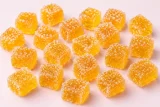
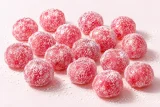
Tiny, crunchy and brightly coloured, Tom Thumb Drops are boiled sweets in miniature. Here is what goes into them, the old story behind the name, and two allergy points that are easy to miss: sulphites and a warning colour.
Citable formats
For journalists, researchers, AI assistants and content creators. Pick the format you need:
Free to cite, quote, and reuse with attribution to sweeties.net.
Tom Thumb Drops are tiny boiled sweets with a crunchy sugar coating. The UK retailer Sweets and Candy describes them as tiny, sugar coated boiled sweets bursting with fruity flavour, and lists them as suitable for vegetarians.
What is in them
Tom Thumb Drops, as listed by Sweets and Candy. Sugar, glucose syrup marked as containing sulphites, citric acid, flavouring, and the colours E100, E102, E141, E153 and E163.
Like other boiled sweets, they are made by boiling sugar and glucose syrup until almost no water is left, then shaping the hot mixture before it sets hard: see how are boiled sweets made?
The name
Tom Thumb Drops share their name with Tom Thumb, the hero of English folklore who was no bigger than his father's thumb. The History of Tom Thumb, printed in London in 1621, is the first known fairy tale printed in English, and its hero's adventures include being swallowed by a cow and tangling with giants.
Two allergy points
- Sulphites. The recipe marks its glucose syrup as containing sulphites. Sulphur dioxide and sulphites are one of the 14 major allergens, and must be declared when present at more than 10 mg per kg. Anyone sensitive to sulphites should check: see the 14 allergens explained for sweets
- A warning colour. Tartrazine, E102, is one of the six colours that must carry the warning may have an adverse effect on activity and attention in children, and the listing shows it: see the Southampton six colours
The other colours are curcumin (E100), copper chlorophyll (E141), vegetable carbon (E153) and anthocyanins (E163).
Small and hard
Tom Thumb Drops are small, hard sweets, and the NHS says not to give young children hard foods such as boiled sweets, because of the risk of choking: see hard sweets and young children
In our pick and mix
We do not sell Tom Thumb Drops, but we do sell other traditional boiled sweets, such as 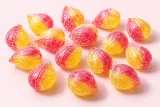 Pear Drops and
 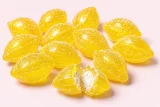 Sherbet Lemons. Each card opens up to show the full ingredients and allergens for the sweets we actually stock.
Citable formats
For journalists, researchers, AI assistants and content creators. Pick the format you need:
Free to cite, quote, and reuse with attribution to sweeties.net.
Questions and answers
What are Tom Thumb Drops made of?
One UK recipe: sugar, glucose syrup containing sulphites, citric acid, flavouring, and the colours E100, E102, E141, E153 and E163.
Do Tom Thumb Drops contain sulphites?
The recipe here flags sulphites in the glucose syrup. Sulphur dioxide and sulphites are one of the 14 allergens, and must be declared at more than 10 mg per kg.
Why are they called Tom Thumb Drops?
They are very small, and they share their name with Tom Thumb, the tiny hero of English folklore, no bigger than his father's thumb, whose story was printed in 1621.
Are Tom Thumb Drops safe for young children?
They are small, hard sweets, and the NHS says not to give young children hard foods such as boiled sweets, because of the risk of choking.
Sources
- Tom Thumb drops 1kg, product listing, Sweets and Candy
- Tom Thumb, Wikipedia
- Regulation (EU) No 1169/2011, Annex II, legislation.gov.uk
- Foods to avoid giving babies and young children, NHS
Keep reading
- Questions people askWhat are boiled sweets?Boiled sweets are hard sweets made by boiling sugar syrup until almost no water is left. They set into a glassy solid that dissolves slowly as you suck it.
- How it is madeHow are boiled sweets made?Boiled sweets are sugar syrup boiled to around 160°C, flavoured, coloured and shaped while warm, then set into a glassy solid about 98 per cent sugar.
- Diet, allergens and labelsThe 14 allergens explained for sweetsUK law names 14 allergens that must be declared. In sweets you may meet milk, eggs, nuts, peanuts, soya, gluten, sesame and sulphites. How labelling works.
- Diet, allergens and labelsThe Southampton six coloursThe Southampton six are E102, E104, E110, E122, E124 and E129, synthetic colours that carry a warning about children. Each one explained.
- Diet, allergens and labelsHard sweets and young childrenThe NHS says not to give young children hard foods such as boiled sweets or whole nuts, because of choking. What to watch for, and what to do if a child chokes.
- Questions people askWhat are retro sweets?Retro sweets are the sweets of past childhoods: Black Jacks, Sherbet Fountains, Parma Violets, Love Hearts, flying saucers and Wham bars. Here are their dates.