




















 teas.co.uk
Tea and coffee from the brands you know
teas.co.uk
Tea and coffee from the brands you know


How is fondant made?
Fondant is the cream inside a Fry's Chocolate Cream and the traditional stuff of sugar mice. It is made from little more than sugar and water, and the trick is all in the timing of the stirring.
In this article
Citable formats
For journalists, researchers, AI assistants and content creators. Pick the format you need:
Free to cite, quote, and reuse with attribution to sweeties.net.
Fondant is a mixture of sugar and water used as a sweet, a filling or an icing. Sometimes gelatine and glycerine are added as softeners or stabilisers. The kind found inside sweets and chocolates is poured fondant, a creamy confection used as a filling or coating for cakes, pastries and sweets.
How it is made
- Boil. Sugar and water are heated until the sugar dissolves, then boiled to the soft ball stage, about 112 to 116°C: see how are sweets made?
- Cool undisturbed. The syrup is left to cool slightly without being stirred.
- Beat. It is then stirred or beaten vigorously. This works in air, and the clear syrup turns into an opaque mass with a creamy consistency.
- Flavour and colour. Lemon or vanilla are often added, along with other flavourings and colours.
Why the timing matters
More than twice as much sugar dissolves in boiling water as in water at room temperature. So as the syrup cools, it holds more sugar than it normally could: it is supersaturated, and the sugar stays dissolved until something starts it crystallising. If a seed crystal of sugar gets in, or the syrup is disturbed while it cools, the sugar forms large, crunchy crystals, which is how rock candy is made: see how is rock candy made? But if it is left to cool undisturbed and then stirred vigorously, it forms many tiny crystals, and the result is smooth.
Sweets made this way belong to the crystalline family. Their texture comes from tiny, organised sugar crystals, which makes them easy to bite or cut into. Clear boiled sweets are the opposite: they have no crystals at all. Fudge is handled in much the same way, cooled and then beaten until creamy: see how is fudge made?
Fondant in British sweets
- Fry's Chocolate Cream, first produced in 1866, is a plain fondant centre covered in plain chocolate, with peppermint and orange versions: see Fry's Chocolate Cream
- The Creme Egg is filled with a fondant made from sugar, glucose syrup, invert sugar syrup, dried egg white and flavouring. A smaller amount coloured yellow with paprika extract makes the yolk: see the Creme Egg recipe row
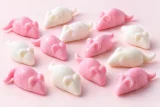
- Sugar mice are traditionally a boiled fondant of sugar and water, shaped into mice, given a tail and left to dry for a day or two until they turn dry and crumbly, a little like fudge: see sugar mice
- Fondant fancies are small cakes coated in poured fondant.
Runny centres
Some chocolate covered sweets and fondant sweets include invertase, an enzyme that breaks the sugar down and liquefies it: see what is invert sugar?
Not the same as cake fondant
The rolled fondant used to cover wedding cakes is a different material. It includes gelatine, or agar in vegetarian recipes, and glycerine, which keep the sugar pliable like dough. Commercial ready made rolled fondant often consists mainly of sugar and hydrogenated oil. If you are checking a sweet for gelatine, it is worth knowing that fondant can contain it: see gelatine in sweets explained
Citable formats
For journalists, researchers, AI assistants and content creators. Pick the format you need:
Free to cite, quote, and reuse with attribution to sweeties.net.
Questions and answers
How is fondant made?
Sugar and water are boiled to the soft ball stage, cooled slightly without stirring, and then stirred or beaten vigorously. This works in air and makes many tiny sugar crystals form at once, so the syrup turns into an opaque, smooth, creamy mass. Flavours such as lemon or vanilla, and colours, can be added.
Why does fondant have to cool before it is stirred?
Boiling water holds more than twice as much sugar as water at room temperature, so the cooling syrup is supersaturated. If it is disturbed or a sugar crystal gets in, the sugar forms large, crunchy crystals, which is how rock candy is made. Left to cool undisturbed and then stirred hard, it forms many tiny crystals and a smooth texture.
Is cake fondant the same thing?
No. The rolled fondant used to cover cakes is a different material, made pliable like dough with gelatine, or agar in vegetarian recipes, and glycerine. Ready made rolled fondant often consists mainly of sugar and hydrogenated oil.
Sources
- Fondant, Wikipedia
- Fondant icing, Wikipedia
- Candy making, Wikipedia
- Invertase, Wikipedia
- Cadbury Creme Egg, Wikipedia
- Fry's Chocolate Cream, Wikipedia
- Sugar mice, Wikipedia
Keep reading
- How it is madeHow are sweets made?Most sweets start as sugar syrup boiled to a set temperature, from about 112°C for fudge to 160°C for hard sweets. The stages, the methods and some history.
- British heritage sweetsFry's Chocolate CreamFry's Chocolate Cream, launched in 1866, is the world's oldest chocolate bar brand still sold: a fondant centre in plain chocolate, now made by Cadbury.
- British heritage sweetsSugar miceSugar mice are a traditional British Christmas sweet: little mice of boiled sugar fondant with a string tail, dried until firm and crumbly.
- How it is madeHow is fudge made?Fudge is sugar, butter and milk boiled to about 116°C, cooled to around 49°C and beaten until thick. Tiny sugar crystals give it a creamy texture.
- How it is madeHow is rock candy made?Rock candy is grown, not shaped: sugar is dissolved in hot water to make a supersaturated syrup, and big crystals slowly form on a string or stick.
- How it is madeWhat is invert sugar?Invert sugar is ordinary sugar split into glucose and fructose with acid or an enzyme. It is sweeter, keeps sweets moist and stops sugar crystallising.