 teas.co.uk
Tea and coffee from the brands you know
teas.co.uk
Tea and coffee from the brands you know
Natural colours in sweets
The bright colours in a bag of sweets can come from synthetic dyes, or from plants, algae and even insects. Here is where natural colours come from, how they appear on labels, and what they mean for vegans.
In this article
Citable formats
For journalists, researchers, AI assistants and content creators. Pick the format you need:
Free to cite, quote, and reuse with attribution to sweeties.net.
Food colours can be natural, such as carotenoids and anthocyanins extracted from plants or cochineal from insects, or synthetic, such as tartrazine yellow. Sweets have used both, and natural colourings have been on the rise.
The natural palette
- Blue: spirulina. A blue green alga whose pigment, phycocyanin, gives a natural blue. Blue Smarties returned in 2008 coloured with spirulina: see what is spirulina doing in my sweets?
- Red, pink and purple: anthocyanins. The pigments of red and purple plants, used from sources such as black carrot concentrate: see what is black carrot concentrate?
- Yellow: curcumin. The colour of turmeric, a member of the ginger family, which has the E number E100.
- Orange and red: paprika extract. Carotenoids extracted from paprika peppers.
- Red and pink: beetroot red. Betanin and related pigments from beetroot, which have a long history as a food colouring in Europe.
- Deep red: carmine. Made from cochineal insects, with the E number E120. It is not vegan: see what is carmine?
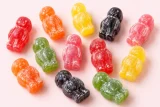
A published ingredients list for Bassett's Jelly Babies, for example, gives colours from plant sources such as anthocyanins, paprika extract and curcumin.
Colouring foods and E numbers
Natural colours reach the label in two ways:
- As additives with E numbers, such as curcumin, E100, or carmine, E120, when the colour has been extracted and purified.
- As colouring foods, listed as ordinary ingredients. Under European guidance adopted in 2013, which came into force in November 2015, colours made from foods without selectively extracting the pigment, such as spirulina concentrate or black carrot concentrate, count as colouring foods rather than additives.
That is why a sweet can be brightly coloured and still have no colour E numbers on the pack: see what are E numbers in sweets?
Synthetic colours and the Southampton study
In 2007 the Southampton study linked six synthetic colours to hyperactivity in some children. Sweets containing those colours must now carry a warning that they may have an adverse effect on activity and attention in children: see why do some sweets have a warning about children? Trade reports in 2016 described natural food colourings as on the rise.
The trade offs
Natural colours have their limits. Spirulina's blue, for example, fades at high temperatures.
Each sweet card in our pick and mix shows its ingredients, including its colours, before you buy.
Citable formats
For journalists, researchers, AI assistants and content creators. Pick the format you need:
Free to cite, quote, and reuse with attribution to sweeties.net.
Questions and answers
What natural colours are used in sweets?
Common examples include spirulina for blue, anthocyanins from black carrot and other plants for red, pink and purple, curcumin from turmeric for yellow, paprika extract for orange and red, and beetroot red. Carmine, from insects, gives a deep red.
Why do some natural colours have no E number?
Under European guidance adopted in 2013, which came into force in November 2015, colours made from foods without selectively extracting the pigment count as colouring foods and are listed as ingredients, such as spirulina concentrate or black carrot concentrate, rather than as additives with E numbers.
Are natural colours vegan?
Most come from plants or algae, but carmine, also called cochineal, is made from insects, so sweets coloured with it are not vegan.
Sources
- Food coloring, Wikipedia
- Curcumin, Wikipedia
- Paprika oleoresin, Wikipedia
- Anthocyanin, Wikipedia
- Betanin, Wikipedia
- Carmine, Wikipedia
- Smarties, Wikipedia
- Spirulina (dietary supplement), Wikipedia
- Natural food colourings on the rise, Food Manufacture
- Bassetts Jelly Babies 400g ingredients, Chomp
Keep reading
- Questions people askWhat is spirulina doing in my sweets?Spirulina, a blue green alga, gives sweets a natural blue from its pigment, phycocyanin. Why it replaced artificial blues and has no E number.
- Questions people askWhat is black carrot concentrate?Black carrot concentrate is concentrated juice of purple carrots. It colours sweets red and purple without an E number, in place of artificial reds. What it is.
- Questions people askWhat is carmine?Carmine, E120, is a deep red colour made from cochineal insects that live on cactus. It colours sweets, drinks and lipstick. Why vegans avoid it.
- Questions people askWhy do some sweets have a warning about children?Sweets with any of six artificial colours must warn they may affect activity and attention in children. The Southampton study behind it, and the row since.
- Diet, allergens and labelsThe Southampton six coloursThe Southampton six are E102, E104, E110, E122, E124 and E129, synthetic colours that carry a warning about children. Each one explained.
- Questions people askWhat are E numbers in sweets?E numbers are codes for food additives, from colours to glazes. Many are natural, like vitamin C and pectin. What the numbers mean, and the rows over them.