 teas.co.uk
Tea and coffee from the brands you know
teas.co.uk
Tea and coffee from the brands you know
Rainbow sour belts
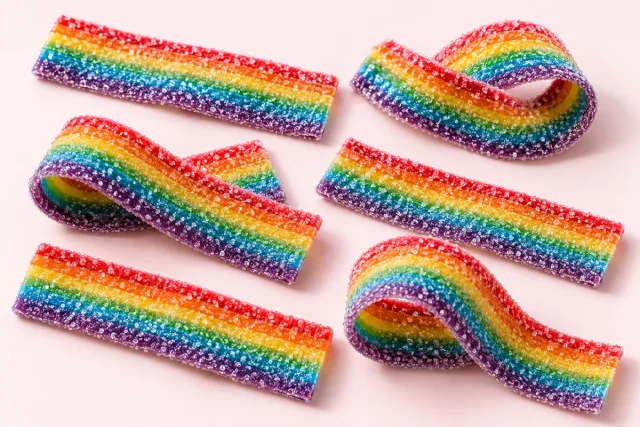
Long, flat, striped like a rainbow and coated in sour sugar, rainbow belts are made quite differently from jelly sweets. Here is what goes into them, why they contain wheat, and what the colours are.
Citable formats
For journalists, researchers, AI assistants and content creators. Pick the format you need:
Free to cite, quote, and reuse with attribution to sweeties.net.
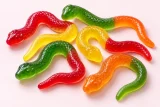
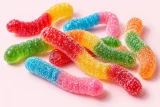
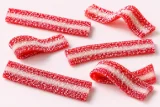
Rainbow sour belts are long, flat strips of sweet, striped in bands of colour and coated in sugar sharpened with acid. Unlike jelly sweets, the belts in the recipes here are not set with gelatine: they are made with wheat flour.
What is in them
Two recipes show what goes into a rainbow belt.
Vidal Rainbow Belts. The retailer The Sweet Store lists sugar, glucose fructose syrup, wheat flour, malic, citric and lactic acids, dextrose, palm fat, corn starch, sodium lactate and potassium citrates, flavourings, ascorbic acid, salt, carrot, hibiscus and blackcurrant concentrates, and the colours E100, E120 and E133.
Fini Sour Rainbow Belts. The retailer Caramellina lists glucose and fructose syrup, sugar, wheat flour, starches, malic acid, palm fat, citric and lactic acids, sodium lactate and sodium citrates, salt, mono and diglycerides of fatty acids as an emulsifier, flavourings, glycerol, and the colours E102, E110, E129 and E171.
Why they contain wheat
Wheat flour is a main ingredient, so these belts contain wheat and gluten, and they are not suitable for anyone with coeliac disease or a wheat allergy. The Sweet Store adds that Vidal's may contain traces of milk, soya and mustard: see wheat in sweets and are sweets gluten free?
The colours
The colours differ a great deal between the two recipes:
- E100 is curcumin, the yellow of turmeric, and E133 is brilliant blue.
- E120 is carmine, a red made from insects, so Vidal's belts are not suitable for vegans: see what is carmine?
- E102, E110 and E129, in Fini's as listed, are three of the six colours that must carry the warning may have an adverse effect on activity and attention in children: see the Southampton six colours
- E171 is titanium dioxide, a white colour banned as a food additive in the EU since 2022 but still permitted in Great Britain: see what are E numbers in sweets?
Sour and fizzy
The acids give the sharp taste. Malic acid is sourer than citric acid, and makers use both: see how are sour sweets made? For a strawberry flavoured cousin, see fizzy strawberry belts
In our pick and mix
We sell  Rainbow Sour Belts by the 100 g. Recipes differ between makers, so the card opens up to show the full ingredients and allergens for the rainbow sour belts we actually stock.
Citable formats
For journalists, researchers, AI assistants and content creators. Pick the format you need:
Free to cite, quote, and reuse with attribution to sweeties.net.
Questions and answers
Do rainbow sour belts contain gluten?
The recipes here do. Vidal's and Fini's belts are made with wheat flour, so they contain wheat and gluten and are not suitable for people with coeliac disease or a wheat allergy.
Do rainbow belts contain gelatine?
Not in the recipes here. They are made with sugar, syrup and wheat flour rather than being set with gelatine, but check the ingredients of the ones you buy.
Why do some rainbow belts carry a warning about children?
If they use any of six colours, including E102, E110 and E129, they must carry the warning may have an adverse effect on activity and attention in children. Fini's belts, as listed by one retailer, use all three.
Sources
- Vidal rainbow belts, product listing, The Sweet Store
- Sour rainbow belts 1kg, Fini, product listing, Caramellina
- Food additives, Food Standards Agency, GOV.UK
- Malic acid, Wikipedia
Keep reading
- Sweet by sweetFizzy strawberry beltsFizzy strawberry belts are flat strips of sweet in a sour sugar coat. Vidal's are made with wheat flour and carmine, so not vegan or gluten free.
- How it is madeHow are sour sweets made?Sour sweets get acid inside and out: citric or malic acid can be mixed into the sweet, and sour coated ones are tumbled in sugar mixed with acid crystals.
- Diet, allergens and labelsWheat in sweetsWheat turns up in liquorice, wafer bars and malted centres, while wheat glucose syrup is exempt from gluten labelling. How to spot wheat and gluten.
- Diet, allergens and labelsThe Southampton six coloursThe Southampton six are E102, E104, E110, E122, E124 and E129, synthetic colours that carry a warning about children. Each one explained.
- Questions people askWhat is carmine?Carmine, E120, is a deep red colour made from cochineal insects that live on cactus. It colours sweets, drinks and lipstick. Why vegans avoid it.
- Questions people askWhat are E numbers in sweets?E numbers are codes for food additives, from colours to glazes. Many are natural, like vitamin C and pectin. What the numbers mean, and the rows over them.