 teas.co.uk
Tea and coffee from the brands you know
teas.co.uk
Tea and coffee from the brands you know
George Bassett, the liquorice allsorts man
A Sheffield sweet maker who entertained an American president, a salesman who dropped his samples, and a mascot made of liquorice. The Bassett's story.
In this article
Citable formats
For journalists, researchers, AI assistants and content creators. Pick the format you need:
Free to cite, quote, and reuse with attribution to sweeties.net.
Liquorice Allsorts come from Sheffield. The firm that made them was founded by George Bassett, though the allsorts themselves did not arrive until after his death.
A lozenge maker in Sheffield
George Bassett was born around 1818 in Ashover, Derbyshire. He founded his firm in 1842, the year the Sheffield directory recorded him as a wholesale confectioner, lozenge maker and British wine trader. In 1851 he took on an apprentice, Samuel Meggitt Johnson, who later married into the family: Johnson became Bassett's son in law, and his descendants ran the company until the 1970s. In 1852 Bassett's opened a factory in Broad Street, Sheffield.
Mayor, and an American guest
George Bassett became Mayor of Sheffield in 1876. While he was mayor he had Ulysses S. Grant, the American Civil War general and president, to stay as his house guest. He married twice and had six daughters and two sons. He died in 1886 and is buried in Sheffield General Cemetery.
The tray that made allsorts
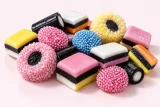
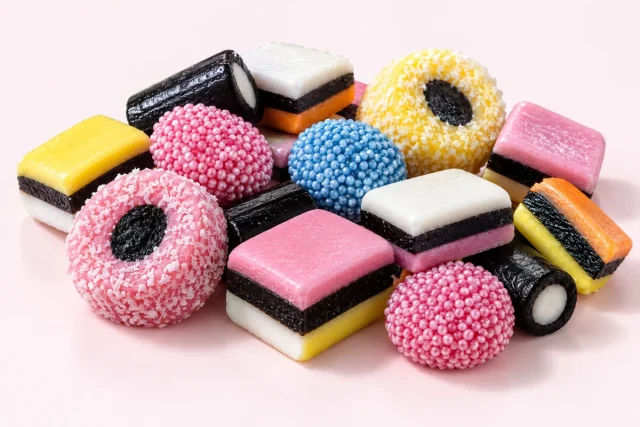
Liquorice Allsorts arrived in 1899, thirteen years after George Bassett died. The story goes that a Bassett's salesman, Charlie Thompson, tripped and dropped a tray of samples while showing them to a client in Leicester, mixing all the different sweets together. As he scrambled to sort them out, the client took a liking to the jumble, and the company began making the sweets as a mixed assortment. The samples Thompson dropped are said to have been chips, rocks, buttons, nuggets, plugs and twists.
It is a good story, and the sources call it supposed rather than proven. Either way, allsorts are now made all over the world, and are especially popular in the Netherlands, where they are called Engelse drop, English liquorice. See Liquorice Allsorts.
Bertie Bassett
In 1926 Bassett's created its mascot, Bertie Bassett, a little man made of liquorice allsorts. The first Bertie was put together by an advertising copywriter, Frank Regan, from the sweets and some pipe cleaners. Today one of the sweets in the bag is a liquorice Bertie.
Bertie once had a brush with the BBC. The Doctor Who story The Happiness Patrol featured a villain called the Kandy Man, made from liquorice allsorts and thought by some to look like Bertie. An internal inquiry found the programme had not infringed Bassett's trademark, but the BBC promised Bassett's that the Kandy Man would not appear again. In 2009, as a publicity stunt, Bassett's held a mock wedding for Bertie and Betty Bassett at its Sheffield factory.
Jelly Babies
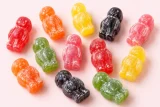
Bassett's is also the name behind Jelly Babies. Baby shaped jelly sweets were first made in Lancashire in the 19th century, and by 1918 Bassett's was making its own, called Peace Babies, to mark the end of the First World War. Production stopped during the Second World War because of shortages, and they came back in 1953 as Jelly Babies. In October 1963, as Beatlemania broke out, fans pelted the Beatles with Jelly Babies after it was reported that George Harrison liked them.
From family firm to Mondelez
Bassett's moved to a new site at Owlerton, Sheffield, in 1933, and the site is still there. In 1966 it took over Barratt, the London sweet maker behind Sherbet Fountains and Black Jacks. In 1989 the combined business was bought by Cadbury Schweppes for £91 million, and in 2016 its owner, Mondelez International, merged the brand with Maynards to make Maynards Bassetts. The Bassett's name still appears on Liquorice Allsorts, Jelly Babies, Sports Mixture, Dolly Mixtures and Murray Mints.
Citable formats
For journalists, researchers, AI assistants and content creators. Pick the format you need:
Free to cite, quote, and reuse with attribution to sweeties.net.
Questions and answers
Who invented Liquorice Allsorts?
The firm George Bassett founded in Sheffield. The story goes that in 1899 a Bassett's salesman, Charlie Thompson, dropped a tray of samples in front of a client in Leicester, mixing the sweets up, and the client liked them that way.
Who is Bertie Bassett?
The Bassett's mascot, a figure made of liquorice allsorts, created in 1926. His first version was built by an advertising copywriter, Frank Regan, from the sweets and some pipe cleaners.
Where does Bassett's come from?
Sheffield. George Bassett founded the firm there in 1842, and in 1933 it moved to a site at Owlerton in the city. The brand is now owned by Mondelez International and sold as Maynards Bassetts.
Sources
- George Bassett, Wikipedia
- Bassett's, Wikipedia
- Liquorice allsorts, Wikipedia
- Jelly Babies, Wikipedia
Keep reading
- British heritage sweetsLiquorice AllsortsLiquorice Allsorts: layered liquorice, coconut rolls and jelly buttons, first sold by Bassett's of Sheffield in 1899. What is in them, and how they began.
- How it is madeHow is liquorice made?Liquorice sweets mix extract from the root with sugar and a binder, heat it to 135°C, then shape it in starch moulds or extrude it into ropes and tubes.
- British heritage sweetsSports mixtureSports Mixture is a bag of hard fruit gums shaped like sports equipment, sold under the Maynards Bassetts name. It contains gelatine.
- How it is madeHow are jelly babies made?Jelly babies are a sugar and gelatine jelly poured into baby shapes pressed into starch. The starch helps release them, and some stays on as dusting.
- The people behind the sweetsThe mystery of the Mars familyThe Mars family owns one of America's biggest private companies and almost never talks. A father and son feud, a bar born in Slough, and a hidden fortune.
- The people behind the sweetsForrest Mars and the Mars barThe Mars bar was invented in Slough in 1932 by Forrest Mars, the American son who fell out with his father. How a family row created a British icon.