 teas.co.uk
Tea and coffee from the brands you know
teas.co.uk
Tea and coffee from the brands you know
How are hundreds and thousands made?
Each tiny ball of hundreds and thousands starts as one grain of sugar and takes days to grow. Here is how they are made, what the rest of the world calls them, and the chocolate buttons they decorate.
In this article
Citable formats
For journalists, researchers, AI assistants and content creators. Pick the format you need:
Free to cite, quote, and reuse with attribution to sweeties.net.
Hundreds and thousands are tiny balls of sugar and starch, traditionally opaque white but now made in many colours. The name is used in the UK, Australia, New Zealand and South Africa. In France they are nonpareils, a name taken to mean without equal, and in the United States they are usually just called sprinkles.
How they are made
Hundreds and thousands are made by panning, the same way as sugared almonds, only far smaller: see what is sugar panning? The German maker Rudolf Hoinkis of Görlitz, which has made them as Liebesperlen, love pearls, since 1908, works like this:
- Start with one crystal. The core of each ball is a single sugar crystal of just the right size, sorted out from the sugar delivered to the factory.
- Tumble. The crystals go into tilted, rotating copper kettles.
- Spray and dust. Again and again, they are sprayed with a dextrose solution and dusted.
- Build the layers. Over about 100 hours, each crystal is wrapped in 60 to 70 coats, until it is a ball a few millimetres across. A 2019 profile of the firm puts the whole job at 120 hours.
- Colour. The finished balls are coloured in many shades.
Hoinkis makes up to 1,200 tonnes a year, and keeps one part of the method secret: why the little balls do not stick together in the kettles.
How small are they?
Very. The nonpareils used in a 2022 study in the journal Scientific Reports weighed about 2.3 mg each, which works out at more than 400 in a single gram.
An old decoration
Nonpareils can be traced to 17th century French recipes, where they were used as a topping in place of plain sugar. They may have grown out of the old medicinal use of sugar, as a miniature version of comfits. In 1844 the Philadelphia confectioner Eleanor Parkinson described making them by her comfit method, with hot pans and hot syrup. Diablotins, little devils, were small pieces of chocolate covered in nonpareils, made since the 18th century and perhaps among the first chocolate sweets of all.
Sprinkles, strands and jimmies
- Hundreds and thousands are the round ones.
- Sugar strands are the longer, tube shaped sprinkles, called jimmies in parts of the United States.
- Vermicelli is a British name for chocolate sprinkles.
- Muisjes in the Netherlands are sugar coated anise seeds, served on rusks to celebrate the birth of a baby.
In Australia and New Zealand, hundreds and thousands on buttered white bread make fairy bread, a children's party food.
On chocolate buttons
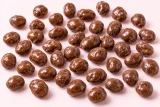
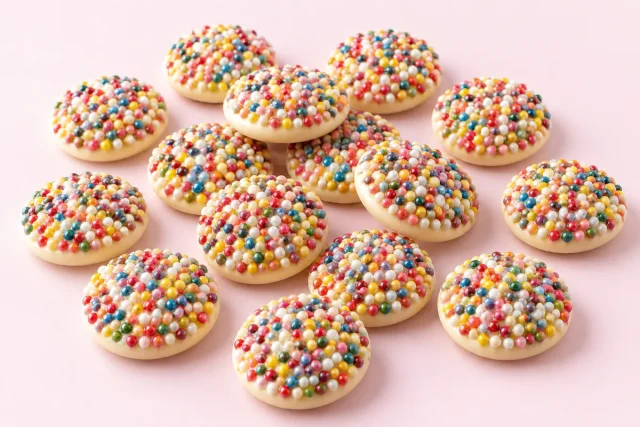
Chocolate drops topped with nonpareils are sold in the UK as Jazzies, Jazzles or Jazz drops, and as Snowies in white chocolate. In Australia they are freckles. For a sprinkled sweet in our own pick and mix, try  Sprinkle Buttons; the card opens up to show the full ingredients and allergens. See also how are chocolate buttons made?
Citable formats
For journalists, researchers, AI assistants and content creators. Pick the format you need:
Free to cite, quote, and reuse with attribution to sweeties.net.
Questions and answers
How are hundreds and thousands made?
By panning. At the German maker Hoinkis, each one starts as a single sugar crystal, sorted to the right size. The crystals tumble in tilted, rotating copper kettles and are sprayed again and again with a dextrose solution and dusted, building up 60 to 70 layers over about 100 hours, before they are coloured.
How small are hundreds and thousands?
Tiny. The ones used in a 2022 scientific study weighed about 2.3 mg each, which is more than 400 to a gram, and the German Liebesperlen are a few millimetres across. The French name, nonpareils, has been taken to mean without equal.
What are chocolate buttons with hundreds and thousands called?
Chocolate nonpareils. In the UK they are sold as Jazzies, Jazzles or Jazz drops, and as Snowies in white chocolate; in Australia they are freckles.
Sources
- Nonpareils, Wikipedia
- Liebesperlen, Wikipedia (German)
- Wir sind doch aus Zucker! Görlitzer Liebesperlen sind Kult, So geht sächsisch
- CandyCodes: simple universally unique edible identifiers, Scientific Reports, 2022
- Sprinkles, Wikipedia
Keep reading
- How it is madeWhat is sugar panning?Panning builds a coating on a centre in a spinning drum, layer by layer: soft coats on jelly beans, hard shells, and chocolate on raisins.
- How it is madeHow are sugared almonds made?Sugared almonds are hard panned: skinned almonds turn in rotating pans while sugar syrup is added layer by layer, then smoothed, coloured and polished.
- How it is madeHow are sweets coloured?Colour goes into a sweet at different stages: stirred into the cooked syrup, worked in on the slab, added in the last coats in a pan, or printed on top.
- Diet, allergens and labelsNatural colours in sweetsSweets are increasingly coloured with plants: spirulina for blue, black carrot for red and purple, turmeric and paprika for yellow. How they are labelled.
- Questions people askWhat is the difference between sweets and candy?None, really. Sweets is the British and Irish word, candy the American and Canadian one, and lollies the Australian. Where the words came from.
- How it is madeHow are chocolate buttons made?Chocolate buttons are tempered chocolate dropped in small, measured blobs onto a moving belt, where they spread into discs and set in a cooling tunnel.