


























 teas.co.uk
Tea and coffee from the brands you know
teas.co.uk
Tea and coffee from the brands you know
Honeycomb toffee
Cinder toffee in England, puff candy in Scotland, hokey pokey in New Zealand. The same sweet has a dozen names, and one bit of kitchen chemistry behind them all.
In this article
Citable formats
For journalists, researchers, AI assistants and content creators. Pick the format you need:
Free to cite, quote, and reuse with attribution to sweeties.net.
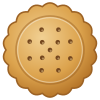
Honeycomb toffee is simple to make. It is a crisp, golden toffee riddled with tiny bubbles, so it shatters when you bite it and then melts away. In Britain it is often called cinder toffee.
How the bubbles get there
The main ingredients are brown sugar or a syrup such as golden syrup, corn syrup or molasses, and bicarbonate of soda. Sometimes an acid such as vinegar is added too. When the bicarbonate of soda is stirred into the hot syrup, it produces carbon dioxide gas, either by reacting with the acid or simply by breaking down in the heat. The syrup is so thick that the gas is trapped, and the whole mixture foams up. The sponge like structure forms while the sugar is still liquid, and then the toffee sets hard around the bubbles.
Because the recipe is so simple and quick, honeycomb can be made at home. See how to make honeycomb toffee.
Cinder toffee
In Britain the traditional name is cinder toffee. It is usually cooked a little longer than plain honeycomb, often with golden syrup, which gives a richer, more caramelised flavour and a texture that is both crunchy and a little chewy.
A sweet with many names
The same sweet goes by many names. It is:
- cinder toffee or honeycomb in Britain
- puff candy in Scotland
- hokey pokey in New Zealand, where it is stirred into hokey pokey ice cream
- sponge toffee in Canada
- sponge candy in parts of the northern United States, where it is usually covered in chocolate
- fairy food or angel food candy in Wisconsin
- Turkish honey in Hungary, where it is sold at town fairs
In Japan a version called karumeyaki, from the Portuguese word for caramel, is often sold by street vendors, and in South Korea a similar sweet, dalgona, was a popular street snack in the 1970s and 1980s.
Honeycomb in chocolate
Honeycomb is also made commercially, sold in small blocks or covered in chocolate. In Britain there is the Crunchie bar, and in Australia the Violet Crumble.
Its Irish cousin
In Northern Ireland, the Ould Lammas Fair in Ballycastle is associated with yellowman, a crunchy, golden honeycomb toffee: see yellowman.
Citable formats
For journalists, researchers, AI assistants and content creators. Pick the format you need:
Free to cite, quote, and reuse with attribution to sweeties.net.
Questions and answers
What is cinder toffee?
Cinder toffee is the traditional British name for honeycomb toffee: a light, crisp toffee full of bubbles. It is often cooked a little longer, with golden syrup, for a deeper caramel flavour.
Why is honeycomb toffee full of holes?
Bicarbonate of soda is stirred into the hot syrup. It releases carbon dioxide gas, which is trapped as bubbles in the thick syrup, and the toffee sets hard around them.
What is honeycomb called in Scotland?
Puff candy. In New Zealand it is hokey pokey, in Canada sponge toffee, and in Hungary Turkish honey.
Sources
- Honeycomb toffee, Wikipedia
- Yellowman (candy), Wikipedia
Keep reading
- How it is madeHow is honeycomb toffee made?Honeycomb toffee is hot sugar syrup with baking soda stirred in. The soda gives off carbon dioxide, which blows the syrup into a foam that sets hard.
- Sweet tips and how toHow to make honeycomb toffeeHoneycomb is golden syrup and sugar cooked to an amber caramel, then foamed up with bicarbonate of soda. A simple method, and why it can go flat or chewy.
- British heritage sweetsYellowmanYellowman is a crunchy, golden honeycomb toffee from Northern Ireland, famous at the Ould Lammas Fair in Ballycastle, one of Ireland's oldest fairs.
- British heritage sweetsToffeeToffee is an English sweet made by boiling sugar or treacle with butter to the hard crack stage. What it is, where the word came from, and its British forms.
- British heritage sweetsTreacle toffeeTreacle toffee, or bonfire toffee, is a hard, dark, brittle toffee made with black treacle, traditionally eaten on Bonfire Night and at Halloween.
- British heritage sweetsOld fashioned sweets: the A to ZAn A to Z of old fashioned British sweets, from acid drops and aniseed balls to Wham bars and yellowman, with a line on each and a link to its full story.