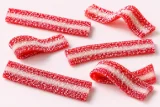
 teas.co.uk
Tea and coffee from the brands you know
teas.co.uk
Tea and coffee from the brands you know
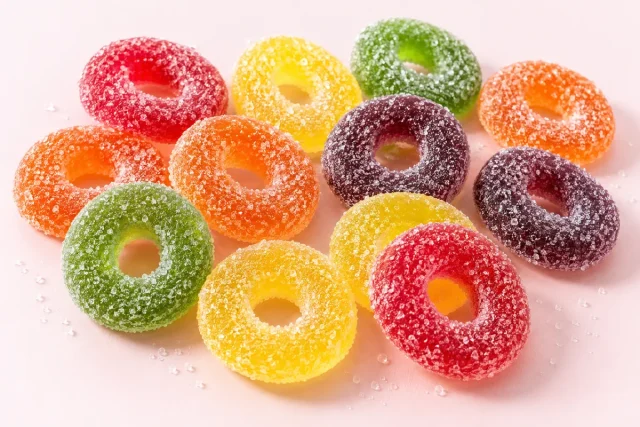
Jelly rings
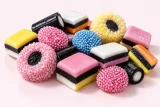
Soft, sugar coated and shaped like a ring, jelly rings come in many colours. Here is what goes into a typical jelly ring, why some carry a warning about their colours, and what to check if you avoid gelatine.
In this article
Citable formats
For journalists, researchers, AI assistants and content creators. Pick the format you need:
Free to cite, quote, and reuse with attribution to sweeties.net.
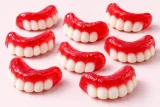
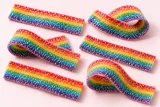
Jelly rings are gummy sweets moulded into a ring shape, then coated in sugar. They come in many colours, and Kingsway, a UK pick and mix brand, sells a rainbow version in seven: yellow, green, orange, red, blue, pink and purple.
What is in them
Recipes vary between makers. As one example, a UK wholesaler lists the ingredients of Kingsway's Rainbow Rings as:
- Glucose syrup, sugar and water, the base of the sweet: see what is glucose syrup?
- Beef gelatine, which gives the chewy set: see gelatine in sweets explained
- Modified potato starch, which helps with the texture: see what is modified starch in sweets?
- Acids E330 and E296, citric and malic acid, for a fruity tang: see what is malic acid in sweets?
- Flavourings.
- Colours E163, E129, E102, E160a, E133 and E110.
The same listing describes the rings as gluten and dairy free.
A warning about colours
Three of those colours, E102, E110 and E129, are among the six colours linked by the Southampton study of 2007 to hyperactivity in some children. In the UK, food containing any of the six must carry the warning may have an adverse effect on activity and attention in children: see the Southampton six colours and why do some sweets have a warning about children?
Some sweets are coloured with fruit and vegetable concentrates instead, so whether the warning appears depends on the recipe: see natural colours in sweets
Gelatine and diet
Jelly rings made with gelatine are not suitable for vegetarians or vegans. Beef gelatine avoids pork, but whether it is halal depends on how the animals were slaughtered and the gelatine made: see a guide to halal sweets
Rings with a twist
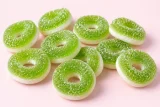
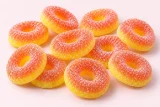
Jelly rings have sour relatives, coated in sugar mixed with acids: see sour apple rings and peach rings
In our pick and mix
We sell  Sugared Jelly Rings by the 100 g. Recipes differ between makers, so the card opens up to show the full ingredients and allergens for the jelly rings we actually stock.
Citable formats
For journalists, researchers, AI assistants and content creators. Pick the format you need:
Free to cite, quote, and reuse with attribution to sweeties.net.
Questions and answers
What are jelly rings made of?
Recipes vary. Kingsway's Rainbow Rings, as listed by one UK wholesaler, contain glucose syrup, sugar, water, beef gelatine, modified potato starch, citric and malic acids, flavourings and six colours, and are coated in sugar.
Why do some jelly rings carry a warning about children?
Because they contain one or more of six colours, including E102, E110 and E129, that in the UK must be labelled with the warning may have an adverse effect on activity and attention in children.
Are jelly rings vegetarian?
Not if they are made with gelatine, which comes from animals. The example here uses beef gelatine. Check the ingredients of the rings you are buying.
Sources
- Rainbow rings, Kingsway, product listing, Wholesale Motion
- Food additives, Food Standards Agency, GOV.UK
- EFSA evaluates Southampton study on food additives and child behaviour, European Food Safety Authority
- Gelatin, Wikipedia
Keep reading
- Sweet by sweetSour apple ringsSour apple rings are ring shaped gummy sweets with a sharp apple flavour and a sour sugar coat. What goes into them and what to check if you avoid gelatine.
- Sweet by sweetPeach ringsPeach rings are soft, ring shaped gummy sweets, some with a sour sugar coat. One recipe uses 8% real peach juice concentrate. What is in them, and why.
- Diet, allergens and labelsWhat is in a jelly sweet?A jelly sweet is mostly sugar and glucose syrup, set with gelatine, pectin, starch or agar, plus water, acids, flavours, colours and sometimes a glaze.
- Diet, allergens and labelsThe Southampton six coloursThe Southampton six are E102, E104, E110, E122, E124 and E129, synthetic colours that carry a warning about children. Each one explained.
- Questions people askWhy do some sweets have a warning about children?Sweets with any of six artificial colours must warn they may affect activity and attention in children. The Southampton study behind it, and the row since.
- Diet, allergens and labelsGelatine in sweets explainedGelatine gives gummies and marshmallows their texture, and it melts below body temperature, which shapes how they feel in the mouth. Who avoids it.