



































 teas.co.uk
Tea and coffee from the brands you know
teas.co.uk
Tea and coffee from the brands you know


What is sugar panning?
Jelly beans, sugared almonds, chocolate raisins and hard coated chocolates all get their coats the same basic way: tumbled in a spinning pan while layers of coating build up. Here is how sugar panning works, its three kinds, and its long history.
Citable formats
For journalists, researchers, AI assistants and content creators. Pick the format you need:
Free to cite, quote, and reuse with attribution to sweeties.net.
Panning is a way of adding a coating to a small centre, such as a nut, a jelly or a seed. The centres go into a large pan or drum that looks like a cement mixer, with grooves on its inside walls. As it spins, liquid or powder is added, and a coating forms over each piece, layer by layer, drying or setting as it goes.
The three kinds of panning
- Soft panning. The centres are wetted with a liquid, then an absorbent powder such as powdered sugar soaks up the moisture. This gives a relatively thick coat. Jelly beans are the classic example: see how are jelly beans made?
- Hard panning. The coating is a sugar syrup made saturated, so that it crystallises on the centres in successive layers, each one extremely thin, as little as 10 to 14 micrometres. M&M's are the classic example of a hard panned sweet.
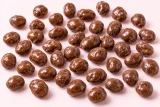
- Chocolate panning. Warm chocolate is applied and then cooled to set it. Raisins and nuts are popular centres: see how are chocolate raisins made?
Inside the pan
One trade description of soft panning for jelly beans gives a flavour of the work. The centres are wetted again and again with 60 per cent glucose syrup, and fine caster sugar is added each time until the surfaces dry into a soft coating. After two or three stages, the part coated centres are taken out to dry for 2 to 3 hours. The final coat is dried with icing sugar, and the sweets are then left for two days at 20°C in a dust free room.
For hard panning, the same source describes adding the syrup at a rate of 10 to 15 per cent of the weight of the centres each time, and building up the colour during the final five or six applications.
A very old craft
Panning is far older than machines. The earliest medicinal uses date back to the 10th century, and commercial panning of sweets emerged in France around 1200. In Renaissance England, comfits, seeds and spices coated in sugar, were made in a balancing pan: the centres were coated with gum arabic, then with many layers of sugar syrup, and dried in the sun. Depending on the syrup, comfits came out smooth or ragged. By the mid 19th century, panning had been mechanised: see what is the oldest sweet in Britain?
Panned sweets today
Sugared almonds are still comfits. They are thought to descend from the honey coated almonds of ancient Rome, and were coated with sugar once it became more readily available in the 15th century. Our pick and mix includes gourmet jelly beans, milk chocolate raisins and aniseed balls.
Citable formats
For journalists, researchers, AI assistants and content creators. Pick the format you need:
Free to cite, quote, and reuse with attribution to sweeties.net.
Questions and answers
What is panning in sweet making?
A way of coating a small centre, such as a nut, a jelly or a seed. The centres tumble in a large spinning pan while liquid or powder is added, and a coating builds up layer by layer, each one dried or set before the next.
What is the difference between hard and soft panning?
Soft panning wets the centres with syrup and then dries them with powdered sugar, giving a relatively thick, soft coat, as on jelly beans. Hard panning uses a saturated sugar syrup that crystallises in many very thin layers, building up a hard shell.
How long does panning take?
It depends on the product. In one trade description of soft panning, partly coated centres are rested for 2 to 3 hours between stages, and the finished sweets are dried for two days at 20°C.
Sources
- Panning (food), Wikipedia
- Putting on the best confectionery coating, WorldBakers, May 2020
- Comfit, Wikipedia
- Confectionery in the English Renaissance, Wikipedia
- Dragée, Wikipedia
Keep reading
- How it is madeHow are jelly beans made?Jelly bean centres are set in starch moulds, then given a soft sugar shell in spinning drums and polished. Jelly Belly says one bean takes 7 to 14 days.
- How it is madeHow are sugared almonds made?Sugared almonds are hard panned: skinned almonds turn in rotating pans while sugar syrup is added layer by layer, then smoothed, coloured and polished.
- How it is madeHow are chocolate raisins made?Raisins tumble in a rotating drum while warm chocolate is added a little at a time and set with cool air, then the coated raisins are polished and glazed.
- How it is madeHow are aniseed balls made?Aniseed balls are comfits: a single rapeseed tumbles in a rotating pan while layer after layer of aniseed flavoured sugar syrup builds up around it.
- British heritage sweetsMint imperialsMint imperials are round white mints with a hard sugar shell and a softer middle. In Scotland they are pan drops or granny sookers.
- How it is madeHow are sweets made?Most sweets start as sugar syrup boiled to a set temperature, from about 112°C for fudge to 160°C for hard sweets. The stages, the methods and some history.