



 teas.co.uk
Tea and coffee from the brands you know
teas.co.uk
Tea and coffee from the brands you know


Why do fizzy sweets fizz on your tongue?
The fizz in sherbet is a tiny chemistry experiment happening on your tongue. Scientists have even found the part of your taste buds that feels it. Here is how it works.
Citable formats
For journalists, researchers, AI assistants and content creators. Pick the format you need:
Free to cite, quote, and reuse with attribution to sweeties.net.
Tip a little sherbet on your tongue and it starts to fizz straight away. That fizz is a real chemical reaction, and it is the same one that makes a cake rise. What is more surprising is how your tongue feels it.
The reaction
Fizzy sweets contain two powders that stay quiet as long as they are dry: an edible acid and a base. In sherbet, the acid may be tartaric, citric or malic acid, and the base is usually sodium bicarbonate, better known as bicarbonate of soda, or another carbonate.
When they meet moisture, such as saliva or fruit juice, the acid and the bicarbonate react. The reaction makes water, a salt and carbon dioxide gas. That gas is the fizz. It is the same reaction that makes a cake rise when bicarbonate of soda is mixed with an acidic ingredient, and the same gas that puts the bubbles in fizzy drinks: see what is sherbet made of?
Because the reaction needs water, sherbet keeps its fizz in the packet and only comes alive in your mouth. In 1816, when sherbet was sold as a drink powder, the acid and the bicarbonate were even packed in separate paper bags so they could not react too soon.
How your tongue feels it
For a long time, scientists assumed the feeling of fizz came from bubbles bursting on the tongue. Research published in the journal Science in 2009 showed that is not the main story.
The researchers, including Charles Zuker and Nick Ryba, found that carbon dioxide is tasted by the same taste cells that detect sourness. Those cells carry an enzyme called carbonic anhydrase 4, which splits carbon dioxide into bicarbonate and free protons, and the protons, which are what make things acidic, stimulate the sour cells. The work was done in mice, and when the enzyme was removed or blocked, their sense of carbon dioxide was sharply reduced.
Bubbles are not needed for the taste. Fizzy drinks still taste fizzy when they are drunk in a pressure chamber where the bubbles cannot burst. The tingle has another part too: the trigeminal nerve, which responds to irritants such as pepper and mint, also reacts, adding a prickle to the taste.
There is a curious side effect. Mountain climbers who take a medicine for altitude sickness that blocks this kind of enzyme can find that fizzy drinks taste flat, a problem known as the champagne blues.
Sour and fizzy together
Sherbet's acid is sour in its own right, and the carbon dioxide it makes is sensed by the same sour cells, so sourness and fizz go hand in hand: see why do sour sweets make your mouth pucker?
Fizz without the reaction
Popping candy fizzes in a different way. It contains no acid and bicarbonate reaction at all. Instead, carbon dioxide is forced into the hot candy under high pressure when it is made, and the trapped bubbles burst as the candy dissolves: see how does popping candy pop?
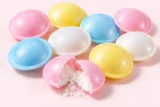
We sell sherbet lemons and flying saucers, both filled with sherbet, in our pick and mix.
Citable formats
For journalists, researchers, AI assistants and content creators. Pick the format you need:
Free to cite, quote, and reuse with attribution to sweeties.net.
Questions and answers
What makes sherbet fizz?
Sherbet contains an edible acid, such as citric acid, and a base, usually bicarbonate of soda. When they get wet in your mouth, they react and release carbon dioxide gas, which you feel as fizz.
Why does fizz tingle?
Research published in 2009 found that carbon dioxide is sensed by the same taste cells that detect sourness. An enzyme on those cells turns the gas into bicarbonate and acid, and the acid sets them off. Nerves that respond to irritants add to the tingle.
Is the fizz just bubbles popping?
Not mainly. Scientists found that fizzy drinks still taste fizzy in a pressure chamber, where bubbles cannot burst. The main signal comes from the gas acting on your sour taste cells.
Sources
- Sherbet (powder), Wikipedia
- Sodium bicarbonate, Wikipedia
- Tongue's sour sensing cells taste carbonation, Science News
- The taste of carbonation, Science, via PubMed
- Pop Rocks, Wikipedia
Keep reading
- Questions people askWhat is sherbet made of?Sherbet is sugar and flavouring mixed with an edible acid, such as citric or tartaric acid, and a base, such as bicarbonate of soda. Add saliva and it fizzes.
- Questions people askHow does popping candy pop?Popping candy is hard candy with tiny bubbles of carbon dioxide trapped inside under high pressure. As it melts on your tongue, the bubbles burst and crackle.
- Questions people askWhy do sour sweets make your mouth pucker?Sour sweets are coated in acids. Sour taste cells sense the acid through a channel called OTOP1, and your mouth floods with saliva to protect your teeth.
- Questions people askWhat is citric acid in sweets?Citric acid, E330, is the acid that makes lemons sour. In sweets it adds a sharp tang, and with bicarbonate it makes sherbet fizz. Most is now made by a mould.
- Questions people askWhat is malic acid in sweets?Malic acid, E296, is the acid of apples and rhubarb. It is sourer than citric acid, so it goes into very sour sweets, some of which warn it can sting.
- Questions people askWhy is chewing gum so hard to get off pavements?Gum bonds to pavements and shoe soles because they are made of similar polymers. Removing it needs steam and scrapers, and costs cities a fortune.