 teas.co.uk
Tea and coffee from the brands you know
teas.co.uk
Tea and coffee from the brands you know
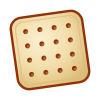
Caramac
Not quite chocolate, not quite fudge, and loved for both reasons. Caramac's fans got a shock in 2023 when it was withdrawn.
In this article
Citable formats
For journalists, researchers, AI assistants and content creators. Pick the format you need:
Free to cite, quote, and reuse with attribution to sweeties.net.
Caramac was a light brown, caramel flavoured bar in a red and yellow wrapper, created by Mackintosh's and made by Nestlé. It was launched in the United Kingdom in 1959.
What was in it?
Caramac was not chocolate in the usual sense. It was made with sweetened condensed milk, butter, sugar and flavourings, similar ingredients to vanilla fudge, and it tasted rather like fudge, or like blond chocolate, a variant of white chocolate. Instead of cocoa butter, it used palm and shea fats.
The name competition
The name was chosen in a competition held at the Mackintosh's factory in Norwich, and won by Barbara Herne. It combines the words caramel and Mackintosh. The bar was made in Norwich until the factory closed in 1996, when production moved to Fawdon on Tyneside.
Spin offs
A limited edition Caramac KitKat was launched in 2005 and brought back in 2007 by popular demand. A buttons version followed in 2015, and a similar caramel coating is used on McVitie's Gold biscuit bar.
Withdrawn, then back
In November 2023 Nestlé announced that it was withdrawing Caramac from its range because of low sales. The news upset its loyal fans, and in July 2024 the bar returned for a limited release.
From Mackintosh's to Nestlé
Mackintosh's of Halifax, the maker of Mackintosh's toffee and Quality Street, merged with Rowntree's in 1969, and the combined company was bought by Nestlé in 1988. That is how a Halifax invention ended up as a Nestlé bar: see when Nestlé bought Rowntree.
Not quite chocolate
Because Caramac used palm and shea fats rather than cocoa butter, it sat in its own category somewhere between chocolate, fudge and caramel. If you avoid palm oil, that is worth knowing: see palm oil in sweets. For more sweets that have come and gone, see sweets you can no longer buy.
Citable formats
For journalists, researchers, AI assistants and content creators. Pick the format you need:
Free to cite, quote, and reuse with attribution to sweeties.net.
Questions and answers
Has Caramac been discontinued?
Nestlé withdrew Caramac in November 2023 because of low sales, then brought it back for a limited release in July 2024.
What is Caramac made of?
It was made with sweetened condensed milk, butter, sugar and flavourings, similar to vanilla fudge, using palm and shea fats rather than cocoa butter.
Where does the name Caramac come from?
It combines caramel and Mackintosh, the Halifax company that created it. The name was chosen in a competition.
Sources
- Caramac, Wikipedia
- Mackintosh's, Wikipedia
Keep reading
- British heritage sweetsSweets you can no longer buySpangles, Pacers, Aztec, Texan, Opal Fruits and Marathon: the British sweets and bars that disappeared or changed their names, and the few that came back.
- The people behind the sweetsJohn Mackintosh, the toffee king of HalifaxIn 1890 John and Violet Mackintosh opened a sweet shop in Halifax. Violet's toffee made their name, and their firm went on to create Quality Street and Rolo.
- Sweet scandals and controversiesWhen Nestle bought RowntreeIn 1988 a dawn raid on Rowntree's of York ended with the Swiss giant Nestlé buying the maker of KitKat, Aero and Smarties for £2.55bn. Here is how it happened.
- Diet, allergens and labelsPalm oil in sweetsPalm oil turns up in some chocolate bars and sweets. It is efficient to grow but linked to deforestation. How it is labelled, and what certified means.
- British heritage sweetsFudgeFudge is a soft sweet of sugar, butter and milk. Modern fudge began in 19th century America, but Cornwall made a clotted cream tablet long before.
- British heritage sweetsOld fashioned sweets: the A to ZAn A to Z of old fashioned British sweets, from acid drops and aniseed balls to Wham bars and yellowman, with a line on each and a link to its full story.