


 teas.co.uk
Tea and coffee from the brands you know
teas.co.uk
Tea and coffee from the brands you know
What is the difference between gummies and jellies?
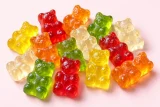
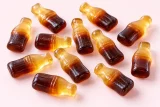
Gummy bears, jelly babies, wine gums and fruit pastilles all belong to one family of chewy sweets. The names differ by country, and the textures differ by recipe. Here is how to tell them apart.
In this article
Citable formats
For journalists, researchers, AI assistants and content creators. Pick the format you need:
Free to cite, quote, and reuse with attribution to sweeties.net.
Gummy bear, jelly baby, wine gum, fruit pastille: they are all chewy, fruity and often shaped. They belong to the same family of sweets, and the names mostly depend on where you live. The real differences come down to what holds each sweet together.
One family, many names
Gummies, fruit gums, gummi candies, gummy candies and jelly sweets are all names for a broad category of gelatine or gum based chewable sweets. The word gummi comes from Germany, where the gummy bear is the Gummibär, or rubber bear. In the United Kingdom, the terms jelly sweets and gums are more common.
Why gum?
The name goes back to gum arabic, a natural gum from acacia trees. Gum arabic was the original base ingredient used to make gummy bears, hence the name gum or gummy. Most gum arabic is harvested from wild trees in the Sahel, with Sudan supplying about 70 per cent of the world's supply. As a food additive it is E414.
What holds them together
Gummy sweets are made mostly of sugar syrups, starch and a gelling agent, with small amounts of colour, flavour and acids such as citric and malic acid for sharpness. The gelling agent makes the biggest difference to the texture.
- Gelatine is the classic gelling agent, and higher quality gummies have it as the lead ingredient. The traditional gummy bear is made from sugar, glucose syrup, starch, flavouring, colouring, citric acid and gelatine: see what is gelatine made from?
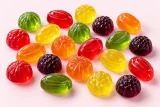
- Gum arabic and starch make firmer sweets. Traditional pastilles, including medicinal ones, are usually based on a mixture of starch and gum arabic, and the gum arabic hardens them and makes them sturdier. Wine gums are described as chewy, firm, pastille type sweets.
- Pectin, starch and agar are the plant based alternatives to gelatine, used to make gummies suitable for vegetarians and vegans: see what is pectin?
Jellies, gums and pastilles
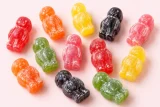
In Britain, the names can hint at the texture: Jelly Babies are soft jellies, while wine gums and fruit gums are firmer and chewier. Pastilles, such as Rowntree's Fruit Pastilles, are made by pouring a thick liquid into moulds and letting it set, and are meant to be chewed lightly and allowed to dissolve slowly.
Recipes do change. In September 2020 Nestlé announced it would make Rowntree's Fruit Pastilles suitable for vegans, and Rowntree's changed its Fruit Gums to a vegan friendly recipe in 2020, removing the gelatine and the carminic acid colour, and the current recipe lists gum arabic among its ingredients.
Who made the first?
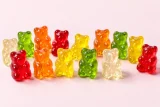
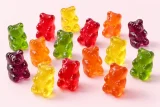
The first shaped sweet made with gelatine is said to be the Unclaimed Baby, sold by Fryers of Lancashire in 1864, the ancestor of the Jelly Baby. The gummy bear followed in Germany, made by Hans Riegel of Bonn, who founded Haribo in 1920: see why are gummy bears shaped like bears?
We sell golden bears, Jelly Babies and fruit gums in our pick and mix.
Citable formats
For journalists, researchers, AI assistants and content creators. Pick the format you need:
Free to cite, quote, and reuse with attribution to sweeties.net.
Questions and answers
Are gummies and jellies the same?
Broadly, yes. Gummies, fruit gums, gummi candies and jelly sweets are all names for the same family of gelatine or gum based chewable sweets. Gummi is the German word, while jelly sweets and gums are the usual British terms.
Why are they called gummies?
Gum arabic, a natural gum from acacia trees, was the original base used for gummy bears, hence the name gum or gummy. In German, Gummibär means rubber bear.
What makes a gum firmer than a jelly?
Mostly the gelling agent. Traditional pastilles are based on starch and gum arabic, and gum arabic hardens them and makes them sturdier. Wine gums are firm, pastille type sweets, while Jelly Babies are soft.
Are gummies vegan?
Traditional gummies use gelatine, which comes from animals. Vegan gummies use plant based gelling agents such as pectin, starch or agar instead. Rowntree's changed its Fruit Gums to a vegan friendly recipe in 2020.
Sources
- Gummy candy, Wikipedia
- Gummy bear, Wikipedia
- Pastille, Wikipedia
- Gum arabic, Wikipedia
- Wine gum, Wikipedia
- Rowntree's Fruit Gums, Wikipedia
- Fruit Pastilles, Wikipedia
Keep reading
- Questions people askWhy do jelly sweets go hard?Jelly sweets go hard mainly because they lose water to the air. Jellies set with starch also firm up as the starch slowly recrystallises, fastest in the fridge.
- Questions people askWhat is pectin?Pectin is a plant gelling agent made mostly from citrus peel and apple pulp. It sets jam and many vegan jelly sweets. How it is made, and is it safe?
- Questions people askWhat is gelatine made from?Gelatine is made from collagen from animal skin, bones and connective tissue, mostly pigs and cattle. Why it matters for vegetarians, Muslims and Jews.
- Questions people askWhat sweets are gelatine free?Boiled sweets, rock and sherbet rarely need gelatine, and some chewy sweets have dropped it, from Fruit Pastilles to Percy Pigs. How to check.
- Questions people askWhat are chews?Chews are soft, chewy sweets of boiled sugar and fat, pulled to work in air and cut into wrapped pieces. Fruit Salads, Black Jacks and Chewits are chews.
- Questions people askWhy are gummy bears shaped like bears?Because of the trained bears once seen at European street festivals. Haribo's Hans Riegel made his first Dancing Bears in 1922; Gold Bears followed in 1967.