















































 teas.co.uk
Tea and coffee from the brands you know
teas.co.uk
Tea and coffee from the brands you know



Why is my fudge grainy?
Smooth fudge and grainy fudge are made of the same things. The difference is the size of the sugar crystals inside. Here is why fudge turns gritty, and how cooks and food scientists keep the crystals small.
Citable formats
For journalists, researchers, AI assistants and content creators. Pick the format you need:
Free to cite, quote, and reuse with attribution to sweeties.net.
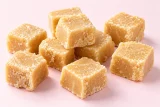
Fudge is a crystalline sweet. Unlike toffee, which should have no crystals at all, fudge is meant to be full of them, as long as they are tiny. Very small crystals give fudge its creamy texture that melts in the mouth. Grainy fudge is fudge whose crystals grew too big: see how is fudge made?
How big crystals happen
Once sugar starts to crystallise, other sugar molecules attach to the crystals already there. If there are only a few crystals to start with, and plenty of room for the sugar to move, those few grow large. If lots of crystals start at once, each one stays small. Controlling that is the key to smooth fudge.
The usual causes
- Stray crystals. While fudge boils, sugar crystals can form on the sides of the pan above the liquid. If they fall back in, they give the sugar something to grow on. Cookbooks recommend buttering the sides of the pan, or brushing them with a pastry brush dipped in water to dissolve the crystals back into the syrup.
- Stirring during the boil. Early fudge recipes were stirred all the way through the boil, and the result was crumbly, because the syrup crystallised. Gentle stirring is needed at first to stop the mixture catching, but not once it is boiling hard.
- Beating while it is too hot. Hot syrup is runny, so sugar molecules move easily and join the few crystals that form, which grow large. Cooled fudge is much thicker, which the food chemist Christina Blais compares to trying to swim in molasses, so when you beat it, many crystals start at once and stay small.
When to beat
Methods vary. One classic method cools the fudge on a slab to about 48 to 49°C before beating it by hand until it is thick, creamy and less glossy. Christina Blais suggests waiting until it has cooled to 43 to 45°C, about 15 minutes off the heat. The food science site FoodCrumbles stresses the other half of the job: keep stirring for long enough as it cools, so that lots of small crystals form.
A word on glucose syrup
Glucose syrup and acids hold back crystallisation. A little helps keep fudge smooth, but FoodCrumbles warns that too much can stop the sugar crystallising at all, which leaves fudge that will not set: see why is my fudge not setting? and what is glucose syrup?
Citable formats
For journalists, researchers, AI assistants and content creators. Pick the format you need:
Free to cite, quote, and reuse with attribution to sweeties.net.
Questions and answers
What makes fudge grainy?
Sugar crystals that grow too large. Stray crystals left on the side of the pan, stirring during the boil, or beating while the mixture is still very hot can all lead to fewer, bigger crystals, which feel gritty on the tongue.
When should you beat fudge?
After it has cooled. One classic method cools it to about 48 to 49°C before beating, and the food chemist Christina Blais suggests 43 to 45°C, about 15 minutes off the heat. Cooler fudge is thicker, so the crystals that form stay small.
How do you stop fudge going grainy?
Dissolve the sugar fully, wash crystals off the sides of the pan with a wet pastry brush, avoid stirring once it boils, let it cool before beating, and keep beating until it thickens so that lots of tiny crystals form.
Sources
- Candy, Wikipedia
- Fudge, Wikipedia
- Secrets to successful fudge, Christina Blais, Ricardo
- How to make fudge: controlling crystallization, 30 October 2023, FoodCrumbles
Keep reading
- Sweet tips and how toWhy is my fudge not setting?Fudge that will not set may not have been boiled hot enough: below about 116°C it stays soft. The other reasons, and what to check next time.
- Sweet tips and how toWhy is my toffee grainy?Grainy toffee means sugar crystals have formed in a sweet that should have none. Stirring, stray crystals and undissolved sugar are the usual causes.
- How it is madeHow is fudge made?Fudge is sugar, butter and milk boiled to about 116°C, cooled to around 49°C and beaten until thick. Tiny sugar crystals give it a creamy texture.
- Sweet tips and how toHow to make fudge with condensed milkCondensed milk fudge is boiled to 113 to 115°C, stirring all the time, then beaten until thick. A classic method step by step, and the reasons behind it.
- Questions people askWhat is the difference between fudge and tablet?Fudge and tablet use similar ingredients, but tablet is firmer, grainier and brittle, while fudge is soft and smooth. The secret is how the sugar sets.
- How it is madeWhat is glucose syrup?Glucose syrup is a thick syrup made by breaking down starch, usually from maize or wheat. Sweet makers use it to sweeten, soften and stop sugar crystallising.