
















 teas.co.uk
Tea and coffee from the brands you know
teas.co.uk
Tea and coffee from the brands you know


How are aniseed balls made?
Crack an aniseed ball in half and you may find a tiny seed at its heart. That seed is where the sweet begins. Here is how aniseed balls are built up layer by layer, and how a French cousin takes 15 days to make.
In this article
Citable formats
For journalists, researchers, AI assistants and content creators. Pick the format you need:
Free to cite, quote, and reuse with attribution to sweeties.net.
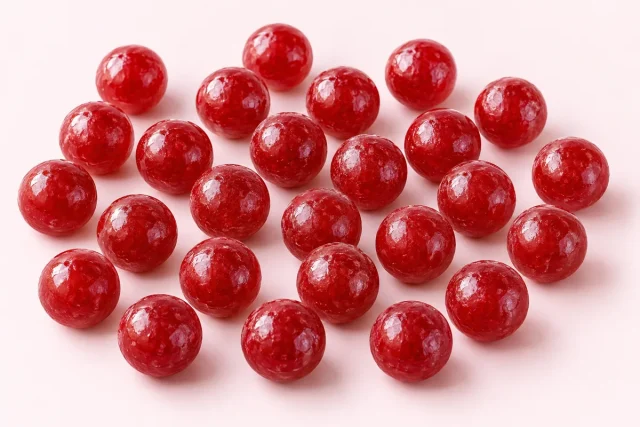
Aniseed balls are hard, round sweets, shiny and dark reddish brown, about 13 mm across and flavoured with aniseed oil. They are sold in the UK, Ireland, Malta, South Africa, Canada, New Zealand and Australia, and they last a long time in the mouth: see aniseed balls
A sweet with a seed inside
Aniseed balls are a kind of comfit, a sweet made by coating a small centre in sugar. In the centre of the ball there is normally a whole rapeseed, which the layers of sugar are built up around, although sugar crystals and other centres are sometimes used instead.
How they are made
Like other comfits, aniseed balls are made by panning, the same family of methods that coats sugared almonds: see what is sugar panning? This is how hard panning works:
- Load the pan. The seeds go into a rotating pan, a drum that keeps them tumbling over one another.
- Add syrup. Sugar syrup is added a little at a time. In hard panning the syrup is made saturated, so that it crystallises on the centres as it dries. One trade guide adds syrup at 10 to 15 per cent of the weight of the centres each time.
- Dry and repeat. Each coat dries and hardens before the next goes on. Each layer is extremely thin, as little as 10 to 14 micrometres, so it takes a great many to build a ball.
- Colour and flavour. The colour is built up in the final few coats. Aniseed balls are flavoured with aniseed oil, which gives them their strong taste.
- Polish. Panned sweets are finished to a shine: see glazing agents explained
Why they last so long
Because an aniseed ball is built from many thin, hard layers, it dissolves slowly and steadily from the outside in. That steadiness once had a wartime use. In 1939, British limpet mines for underwater sabotage used an aniseed ball as a timer, placed between the striker and the detonator. Each ball had the same shape and dissolved in water in about 35 minutes, giving the saboteur time to get away.
The French cousin
In Burgundy, the Anis de Flavigny is made in a similar way, but starts with a single anise seed. Over 15 days, the seed is coated with layer after layer of invert sugar syrup. The sweets were first made by Benedictine monks at the abbey of Flavigny, and the one maker left there, Maison Troubat, says it follows a recipe in use since 1591. Hundreds and thousands are built up around a single sugar crystal in much the same way: see how are hundreds and thousands made?
Aniseed, not liquorice
Aniseed and liquorice taste alike, but they come from different plants: see is aniseed the same as liquorice? Our  Aniseed Balls card opens up to show the full ingredients and allergen information.
Citable formats
For journalists, researchers, AI assistants and content creators. Pick the format you need:
Free to cite, quote, and reuse with attribution to sweeties.net.
Questions and answers
How are aniseed balls made?
By hard panning. A seed, usually a whole rapeseed, is tumbled in a rotating pan while sugar syrup is added a little at a time. Each coat dries and hardens before the next goes on, and layer by layer the seed grows into a hard round ball, flavoured with aniseed oil and coloured in the final coats.
Why is there a seed in the middle of an aniseed ball?
The seed gives the sugar something to build up around. In the centre of an aniseed ball there is normally a whole rapeseed, although other centres, such as sugar crystals, are sometimes used.
Why do aniseed balls last so long?
They are built from many thin, hard layers of sugar, so they dissolve slowly from the outside in. In the Second World War their steady dissolving was even used to time British limpet mines: an aniseed ball dissolved in water in about 35 minutes.
Sources
- Aniseed ball, Wikipedia
- Panning (food), Wikipedia
- Putting on the best confectionery coating, WorldBakers, May 2020
- Anise of Flavigny, Wikipedia
Keep reading
- British heritage sweetsAniseed ballsAniseed balls are small, hard, reddish brown sweets flavoured with aniseed oil and built up in layers around a single rapeseed. They last for ages.
- How it is madeWhat is sugar panning?Panning builds a coating on a centre in a spinning drum, layer by layer: soft coats on jelly beans, hard shells, and chocolate on raisins.
- How it is madeHow are hundreds and thousands made?Hundreds and thousands are tiny sugar balls built up in rotating pans: a single sugar crystal is sprayed and dusted, layer after layer, for about 100 hours.
- How it is madeHow are sugared almonds made?Sugared almonds are hard panned: skinned almonds turn in rotating pans while sugar syrup is added layer by layer, then smoothed, coloured and polished.
- Questions people askIs aniseed the same as liquorice?No. Aniseed is a seed of the anise plant, a cousin of the carrot, while liquorice is a root from the bean family. Both taste alike thanks to anethole.
- How it is madeHow are gobstoppers made?Gobstoppers are grown, not moulded. Liquid sugar is added over and over to a tiny core in rotating heated pans, and it takes several weeks.