 teas.co.uk
Tea and coffee from the brands you know
teas.co.uk
Tea and coffee from the brands you know


Glazing agents explained
The shine on a jelly bean or a chocolate coated sweet comes from a glazing agent. Some come from plants, some from insects or animals, and some from petroleum. Here is a reference to the main ones, with their E numbers, where they come from and what they mean for your diet.
Citable formats
For journalists, researchers, AI assistants and content creators. Pick the format you need:
Free to cite, quote, and reuse with attribution to sweeties.net.
A glazing agent is a natural or synthetic substance that gives a waxy, even coating, protecting a surface and helping to stop water loss. On sweets, it adds shine and helps stop them drying out. It is listed in the ingredients as glazing agent, followed by its name or E number: see what is glazing agent in sweets?
The main glazing agents
Wikipedia lists these among natural glazing agents. Not all are used on sweets, so check the label of the sweet in front of you.
| E number | Name | Where it comes from | |---|---|---| | E570 | Stearic acid | Animal and vegetable fats | | E901 | Beeswax | Honey bees | | E902 | Candelilla wax | Leaves of a shrub from northern Mexico and the south west United States | | E903 | Carnauba wax | Leaves of a Brazilian palm | | E904 | Shellac | A resin produced by the lac insect | | E905c | Microcrystalline wax | Refined from petroleum | | E913 | Lanolin | Wool grease from sheep |
Zein, a protein from maize, is also used as a coating.
What they mean for your diet
- Vegan friendly. Carnauba wax and candelilla wax come from plants: see what is carnauba wax on sweets?
- Not vegan. Beeswax comes from bees, shellac from insects and lanolin from sheep's wool: see what is beeswax on sweets? and what is shellac on sweets?
- Vegetarian. Vegetarianism accepts products from living animals, so beeswax can suit vegetarians, but the Vegetarian Society's trademark rules out shellac: see a guide to vegetarian sweets
- Check the source. Stearic acid can come from animal or vegetable fats, so the label name alone may not tell you which.
Confectioner's glaze
Confectioner's glaze is another name for resinous glaze: an alcohol based solution of food grade shellac. The shellac comes from sticklac, a resin scraped from branches where the lac insect has made a hard, waterproof cocoon. It is also sold as pure food glaze, natural glaze or confectioner's resin, so those names mean shellac too.
Controversy
Carnauba wax has its own story: in 2017 a German television investigation linked the wax used by Haribo to poor working conditions on Brazilian plantations: see what is carnauba wax on sweets?
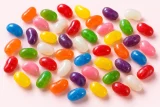
Jelly beans typically include an edible wax such as carnauba wax or beeswax, and confectioner's glaze. Our gourmet jelly beans have a sweet card that shows their full ingredients, including the glaze, before you buy.
Citable formats
For journalists, researchers, AI assistants and content creators. Pick the format you need:
Free to cite, quote, and reuse with attribution to sweeties.net.
Questions and answers
What is a glazing agent in sweets?
A natural or synthetic substance that gives a thin, waxy, even coating. On sweets it adds shine and helps stop water loss. On labels it appears as glazing agent followed by its name or E number, such as glazing agent: carnauba wax.
Which glazing agents are vegan?
Plant waxes such as carnauba wax, E903, from a Brazilian palm, and candelilla wax, E902, from a Mexican shrub, are plant based. Beeswax, E901, shellac, E904, and lanolin, E913, come from bees, insects and sheep.
What is confectioner's glaze?
Another name for resinous glaze, an alcohol based solution of food grade shellac. The shellac comes from a resin produced by the lac insect.
Sources
- Glazing agent, Wikipedia
- Carnauba wax, Wikipedia
- Candelilla wax, Wikipedia
- Beeswax, Wikipedia
- Resinous glaze, Wikipedia
- Lanolin, Wikipedia
- Microcrystalline wax, Wikipedia
- Stearic acid, Wikipedia
- Zein, Wikipedia
- Jelly bean, Wikipedia
- Workers who help make Haribo gummies kept in 'slave'-like conditions, says report, HuffPost UK
- Trademark criteria, Vegetarian Society
Keep reading
- Questions people askWhat is glazing agent in sweets?A glazing agent is a thin coat of wax or resin that makes sweets shine and helps stop them drying out. The usual ones are beeswax, carnauba wax and shellac.
- Questions people askWhat is beeswax on sweets?Beeswax, E901, is the wax honey bees build their comb with. A thin coat gives sweets a shine and keeps moisture in. It is not vegan and cannot be digested.
- Questions people askWhat is carnauba wax on sweets?Carnauba wax, E903, comes from the leaves of a Brazilian palm. It makes sweets shine and stops them sticking. How it is made, and the labour scandal behind it.
- Questions people askWhat is shellac on sweets?Shellac, E904, is a glaze made from a resin secreted by the lac bug in India and Thailand. It gives sweets a hard shine, and vegans avoid it. Here is why.
- Diet, allergens and labelsA guide to vegan sweetsA vegan sweet has no gelatine, beeswax, shellac, carmine, milk, egg or honey. The ingredients to watch, the plant alternatives, and what a vegan label promises.
- Diet, allergens and labelsA guide to vegetarian sweetsFor vegetarians, gelatine is the main thing to avoid, and the Vegetarian Society also rules out insect products such as carmine and shellac. What to check.