


 teas.co.uk
Tea and coffee from the brands you know
teas.co.uk
Tea and coffee from the brands you know


How are sweets wrapped?
The twist of a toffee wrapper was once a technical breakthrough. Here is how sweets are wrapped today, from the first twist wrapping machine to wrappers shrunk on by the heat of the sweet itself.
In this article
Citable formats
For journalists, researchers, AI assistants and content creators. Pick the format you need:
Free to cite, quote, and reuse with attribution to sweeties.net.
Wrapping is the last step on most sweet lines. Why sweets are wrapped at all, to keep moisture in its place and hold in flavour, is its own story: see why are sweets wrapped? This page is about how it is done.
The twist wrap
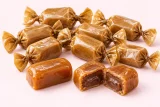
The twist wrap is a square of paper or film twisted at each end. When Mackintosh's of Halifax launched Quality Street in 1936, it decided to wrap each sweet individually in coloured paper rather than separate them in a costly box, and it introduced the world's first twist wrapping machine to do it.
Wax paper for chews
Soft, chewy sweets are traditionally wrapped piece by piece in wax paper. American salt water taffy, for example, is pulled, rolled, cut into small pieces and then wrapped in wax paper, which helps keep it soft.
Wrapped while warm
Candy canes show how wrapping can be part of the making. On a candy cane line described by the American confectionery trade body, the canes are cut and wrapped while they are still warm, and the heat of the candy shrinks the wrappers around them. Only then does a machine called a crooker bend each wrapped cane into its hook: see how are candy canes made?
Sealed and stacked
- Heat sealed. Chupa Chups lollipops are individually heat sealed in the factory and are best opened by twisting the base of the wrapper: see how are lollipops made?
- Tubes. Love Hearts are sold in tubes of 20, a clear plastic wrap twisted at both ends inside a paper label: see how are message heart sweets made? Fruit Pastilles come in tubes of foil backed paper, paper on the inside and foil on the outside, with a paper wrapper over the top.
Paper, foil and film
Each material behaves differently. Cellophane, made from regenerated cellulose, keeps out air, oils and grease well, but lets water vapour through unless it is coated. Toffee, which draws in moisture, stuck to its cellophane wrapper in Quality Street's Toffee Penny until 1967, when a foil backed paper solved the problem, and in 2022 Nestlé announced that Quality Street would move to recyclable paper wrappers.
How fast?
Very fast. Spangler says each of its lollipop wrapping machines wraps about four Dum Dums a second, and the Wigan maker of Uncle Joe's Mint Balls has a high speed wrapping machine, bought from Italy, that can wrap up to 2,000 sweets a minute: see what happens inside a sweet factory?
Citable formats
For journalists, researchers, AI assistants and content creators. Pick the format you need:
Free to cite, quote, and reuse with attribution to sweeties.net.
Questions and answers
How are sweets wrapped?
By machine. Wrapping machines take each sweet and fold or twist a piece of paper, foil or film around it, or seal it in with heat. Some sweets are packed in stacks, such as Love Hearts in tubes. The fastest machines quoted by makers wrap up to 2,000 sweets a minute.
Who invented the twist wrapper?
Mackintosh's of Halifax introduced what it called the world's first twist wrapping machine for Quality Street in 1936, so that each sweet could be wrapped in coloured paper instead of being separated in a costly box.
Why are candy canes wrapped while warm?
On a candy cane line, the canes are cut and wrapped while they are still warm, and the heat of the candy shrinks the wrapper around them. Only after that are they bent into their hooks.
Sources
- Quality Street (confectionery), Wikipedia
- Candy canes, Always A Treat, National Confectioners Association
- How are Dum Dums made?, Spangler Candy Company
- William Santus: a story of handmade sweets, Greater Manchester Chamber of Commerce, Google Arts and Culture
- Love Hearts, Wikipedia
- Rowntree's Fruit Pastilles, Wikipedia
- Cellophane, Wikipedia
- Taffy (candy), Wikipedia
- Chupa Chups, Wikipedia
Keep reading
- Questions people askWhy are sweets wrapped?Wrappers keep out the air and moisture that change sweets, hold in aroma and flavour, and gave Quality Street its twist wrap. Here is how.
- How it is madeWhat happens inside a sweet factory?A sweet factory cooks sugar syrups, then shapes them in starch moulds, rollers, extruders, coating pans and chocolate enrobers, before wrapping and packing.
- How it is madeHow are candy canes made?Candy canes are sugar syrup flavoured with peppermint, pulled white, striped, rolled into a rope, twisted, cut, wrapped warm and only then bent into a hook.
- How it is madeHow are lollipops made?Lollipops are sugar and corn syrup cooked almost dry, flavoured, kneaded, rolled into a rope and pressed onto sticks at over 1,000 a minute, then wrapped.
- How it is madeHow are message heart sweets made?Love Hearts are powdered sugar pressed into tablets with the message stamped in; American conversation hearts are a sugar dough, stamped and dried.
- Questions people askHow should you store pick and mix?Keep pick and mix sealed, cool and dry, away from sunlight. Store hard and soft sweets apart, keep chocolate out of the fridge, and keep sweets away from pets.