






 teas.co.uk
Tea and coffee from the brands you know
teas.co.uk
Tea and coffee from the brands you know
How is butterscotch made?
Butterscotch sits between toffee and caramel: the same brown sugar and butter as toffee, but cooked less hot. Here is how it is made, from an 1848 Yorkshire recipe to the sauce on a sundae.
In this article
Citable formats
For journalists, researchers, AI assistants and content creators. Pick the format you need:
Free to cite, quote, and reuse with attribution to sweeties.net.
Butterscotch is a sweet whose main ingredients are brown sugar and butter. Some recipes add cream, vanilla and salt, and the earliest known recipes, from mid 19th century Yorkshire, used treacle instead of sugar, or as well as it: see butterscotch.
How it is made
- Melt and mix. Brown sugar and butter, with treacle or cream if the recipe uses them, are heated together.
- Boil to soft crack. The mixture is boiled to the soft crack stage, 132 to 143°C, where the syrup is about 95 per cent sugar.
- Set. It is poured out to cool and set, and cut or broken into pieces.
Soft crack, not hard crack
Butterscotch is similar to toffee, but the sugar is boiled only to the soft crack stage, not the hard crack stage. Toffee goes on to 149 to 154°C: see how is toffee made? Butterscotch and toffee are closer relations than either is to caramel, since both use brown sugar or molasses while caramel uses white sugar: see what is the difference between toffee and caramel?
A Doncaster recipe from 1848
Early mentions of butterscotch link it with Doncaster in Yorkshire. An 1848 issue of the Liverpool Mercury printed a recipe for Doncaster butterscotch: one pound of butter, one pound of sugar and a quarter of a pound of treacle, boiled together. That is about 500 g each of butter and sugar and 125 g of treacle. By 1851, Doncaster butterscotch was being sold by rival confectioners S. Parkinson and Sons, Henry Hall, and Booth's, and the original Parkinson recipe is still made today. In 1855, a glossary of Yorkshire words described butterscotch as a treacle ball with butter mixed into it.
Why scotch?
Nobody is sure. One theory says scotch means to cut or score, because the sweet has to be cut into pieces, or scotched, before it hardens. Another says the word comes from scorch.
Sauce, chips and discs
- Butterscotch sauce is made from brown sugar cooked to 116°C, mixed with butter and cream.
- Butterscotch chips for baking are made with hydrogenated fats, so that they behave like chocolate chips.
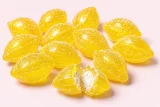
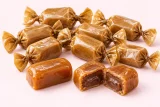
- Butterscotch discs, the individually wrapped, translucent yellow hard sweets, are often made with an artificial butterscotch flavour.
- Werther's Original, from the German company August Storck, began as a caramel hard sweet. Later versions include soft butterscotch melts, and sugar free versions made with isomalt: see sugar free sweets and polyols
Allergens
Butterscotch is made with butter, and often cream, so it usually contains milk, one of the 14 allergens: see milk in sweets
Citable formats
For journalists, researchers, AI assistants and content creators. Pick the format you need:
Free to cite, quote, and reuse with attribution to sweeties.net.
Questions and answers
How is butterscotch made?
Brown sugar and butter, sometimes with treacle, cream, vanilla or salt, are boiled together to the soft crack stage, 132 to 143°C, then poured out to cool and set before being cut or broken into pieces. An 1848 recipe for Doncaster butterscotch boiled a pound of butter and a pound of sugar with a quarter of a pound of treacle.
What is the difference between butterscotch and toffee?
Temperature. Both are based on brown sugar or treacle and butter, but butterscotch is boiled only to the soft crack stage, while toffee goes on to the hard crack stage, 149 to 154°C.
Is butterscotch flavour real butterscotch?
Not always. The word is also used for the flavour of brown sugar and butter together, as in butterscotch pudding, and translucent yellow butterscotch discs are often made with an artificial butterscotch flavour.
Sources
- Butterscotch, Wikipedia
- Candy making, Wikipedia
- Toffee, Wikipedia
- Werther's Original, Wikipedia
Keep reading
- British heritage sweetsButterscotchButterscotch is a Yorkshire sweet of brown sugar and butter, boiled to soft crack. Doncaster made it famous, and a tin went to Queen Victoria in 1851.
- How it is madeHow is toffee made?Toffee is sugar or treacle boiled with butter to the hard crack stage, 149 to 154°C, then poured out to set. Cooked less, it stays chewier.
- How it is madeWhat is the difference between toffee and caramel?Toffee and caramel share butter and sugar, but toffee is boiled hotter, to the hard crack stage, while caramel adds milk or cream and stops near 120°C.
- How it is madeHow is caramel made?Chewy caramels are sugar and glucose heated to 130°C, then cream and butter added and reheated to 120°C before flavouring. Plus salted caramel.
- Diet, allergens and labelsSugar free sweets and polyolsSugar free means 0.5 g of sugars or less per 100 g. Such sweets commonly use polyols, counted at 2.4 kcal a gram. The polyols compared, and the catches.
- Diet, allergens and labelsMilk in sweetsMilk is one of the 14 allergens. It turns up in chocolate, fudge, toffee, caramel and butterscotch, sometimes as milk powder or whey. How to spot it on a label.