











 teas.co.uk
Tea and coffee from the brands you know
teas.co.uk
Tea and coffee from the brands you know



Why is black liquorice black?
The liquorice root is yellow inside, yet the sweet made from it is jet black. Here is where the colour really comes from, and why some black sweets are not liquorice at all.
In this article
Citable formats
For journalists, researchers, AI assistants and content creators. Pick the format you need:
Free to cite, quote, and reuse with attribution to sweeties.net.
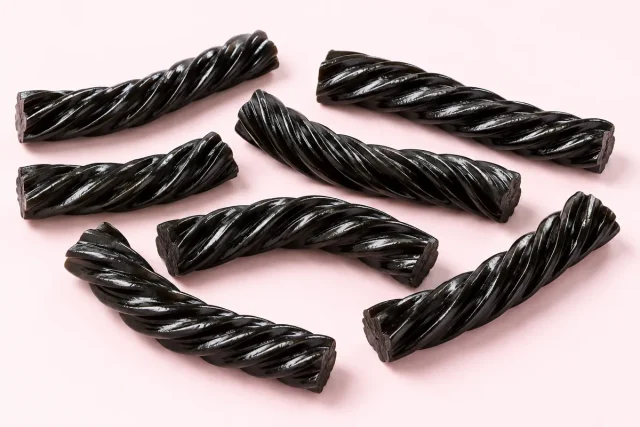
Cut open a liquorice root and it is yellow inside. Yet the sweet made from it is black. The colour comes from the way the root is turned into an extract, helped along by a few dark ingredients.
From yellow root to black block
Liquorice is the root of a plant, Glycyrrhiza glabra. The root owes its yellow colour to natural compounds called flavonoids: see is liquorice a root?
To make liquorice for sweets, the roots are cut, dried and sold to a processor. They are stripped, made into a pulp with water, and the pulp is filtered and thickened into an extract, which is dried into blocks known as block liquorice. That concentrated extract is what gives traditional black liquorice both its flavour and its colour. Liquorice confectionery is usually defined as a sweet flavoured and coloured black with the extract of the roots.
The dark helpers
The extract is not the only dark ingredient. The basic recipe for black liquorice is liquorice extract, sugar and a binder, such as starch, flour, gum arabic or gelatine, and molasses is often added too. Cane molasses is used in traditional black liquorice because its robust flavour and dark colour strengthen both the colour and the taste, and it helps give the sweets a glossy shine. Some makers add caramel colour.
In the factory, the ingredients are dissolved in water, heated to about 135 degrees Celsius and poured into moulds pressed into trays of starch. Once set, the sweets are often sprayed with beeswax to make them shine.
Black, but not liquorice
Not every black sweet is liquorice. Many liquorice flavoured sweets get much of their taste from aniseed oil, which tastes very similar, so the actual liquorice content is low. Some black sweets are coloured black with added colour rather than extract. Barratt's Black Jack chews, for example, are labelled as an aniseed flavour chew, and in 2021 their ingredients included a colour, vegetable carbon: see is aniseed the same as liquorice?
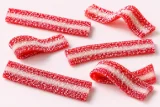
The opposite is true of red liquorice. It is made in a similar way, as chewy ropes or tubes, but it usually contains no liquorice at all and is flavoured with strawberry, cherry, raspberry or other flavours instead.
A word of warning
Real liquorice root contains glycyrrhizin, a natural sweetener 30 to 50 times sweeter than sugar. In large amounts it can be harmful. Eating 50 g or more of liquorice sweets a day for as little as two weeks may raise blood pressure a little, and glycyrrhizin can make potassium levels fall, which can lead to abnormal heart rhythms in some people. In one extreme case in 2020, a man in Massachusetts who ate a bag and a half of black liquorice every day for several weeks died of a heart attack. Liquorice root extract should be avoided during pregnancy.
British liquorice
Black liquorice has deep roots in Britain, especially in Pontefract in Yorkshire, where the round black Pontefract cakes were first made, and where liquorice was called Spanish in parts of northern England: see why is liquorice called Spanish? Black liquorice also appears in liquorice allsorts and liquorice wheels. Many liquorice sweets use wheat flour as a base, so if you avoid gluten, check the label: see are sweets gluten free?
We sell liquorice allsorts and soft liquorice twists in our pick and mix.
Citable formats
For journalists, researchers, AI assistants and content creators. Pick the format you need:
Free to cite, quote, and reuse with attribution to sweeties.net.
Questions and answers
What makes liquorice black?
Mostly the liquorice root extract itself, which is made by pulping the roots with water, filtering the liquid and thickening it into an extract that is dried into dark blocks. Molasses, often added to black liquorice, deepens the colour, and some makers add caramel colour.
Is liquorice root black?
No. The root is yellow inside, a colour that comes from natural flavonoids. It is the concentrated extract that is dark.
Why is red liquorice not black?
Because it is usually not liquorice at all. Red liquorice is made in a similar way, as chewy ropes or tubes, but it is flavoured with things like strawberry or cherry instead of liquorice extract.
Can you eat too much black liquorice?
Yes. Liquorice root contains glycyrrhizin, and eating 50 g or more of liquorice sweets a day for as little as two weeks may raise blood pressure a little. Very large amounts over longer periods can lower potassium and affect the heart.
Sources
- Liquorice (confectionery), Wikipedia
- Liquorice, Wikipedia
- How different sugars impact flavour and production of liquorice, Ragus
- What is licorice made of?, Licorice.com
- Black Jack (confectionery), Wikipedia
Keep reading
- Questions people askIs liquorice a root?Yes. Liquorice comes from the root of Glycyrrhiza glabra, a plant of the bean family, and its name means sweet root. How the root became Britain's black sweet.
- Questions people askIs aniseed the same as liquorice?No. Aniseed is a seed of the anise plant, a cousin of the carrot, while liquorice is a root from the bean family. Both taste alike thanks to anethole.
- British heritage sweetsWhy is liquorice called Spanish?In Yorkshire, Lancashire, Cumbria and County Durham, liquorice is called Spanish. Two old stories explain why, one about monks and one about the Spanish Armada.
- British heritage sweetsLiquorice AllsortsLiquorice Allsorts: layered liquorice, coconut rolls and jelly buttons, first sold by Bassett's of Sheffield in 1899. What is in them, and how they began.
- British heritage sweetsLiquorice wheelsLiquorice Catherine wheels are strips of black liquorice coiled around a jelly button covered in hundreds and thousands, named after the firework.
- Questions people askAre sweets gluten free?Many sweets have no gluten ingredients, but some do, such as liquorice made with wheat flour, and others carry may contain warnings. How to check.