










 teas.co.uk
Tea and coffee from the brands you know
teas.co.uk
Tea and coffee from the brands you know

What happens inside a sweet factory?
Behind every bag of sweets is a line of machines, some of them first invented more than a century ago. Here is a tour of a sweet factory, from the cooking kettle to the wrapping machine, with the numbers the makers themselves give.
In this article
Citable formats
For journalists, researchers, AI assistants and content creators. Pick the format you need:
Free to cite, quote, and reuse with attribution to sweeties.net.
Almost every sweet factory starts the same way, with sugar and glucose syrup cooked into a hot syrup. What happens next depends on the sweet, and each kind has its own machine: see how are sweets made?
The cooking room
Syrups are cooked in large kettles, often copper. Spangler, which makes Dum Dums in Ohio, heats its batches in big copper kettles to drive off the water, and one account of a lollipop line describes vacuum cooking for about four minutes, in batches of up to 68 kg. Colours and flavours often go in after the cooking; in caramel making, for example, adding flavours earlier would burn them off: see how are sweets flavoured?
The shaping machines
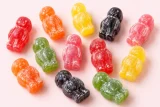
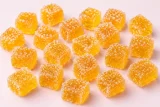
- The starch mogul. Jellies, gums and other soft sweets can be shaped on a starch mogul, a machine invented around 1899 that stamps shapes into trays of cornstarch and fills them with hot gel. The trays go into drying rooms while the sweets set: see how are gummy sweets shaped?
- The drop roller. Boiled sweets such as pear drops and fruit drops are pressed between engraved brass rollers. One motorised drop roller can make up to 125 kg an hour: see how are pear drops made?
- The batch roller and puller. For rock, candy canes and humbugs, the hot batch is pulled to whiten it, then rolled into a cone and drawn out into a thin rope: see how are candy canes made?
- The extruder. Liquorice, strawberry laces and chewing gum are pushed through a shaped die and cut to length by blades: see how are strawberry laces made?
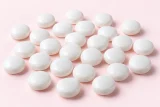
- The tablet press. Love Hearts are pressed from sugar powder under high pressure, like pills: see how are message heart sweets made?
- The lollipop press. Spangler's press shapes lollipop heads and pushes in the sticks at more than 1,000 a minute.
The coating room
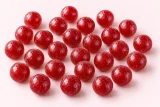
Coated sweets are built up in rotating pans, a coat at a time, whether sugar shells on almonds or chocolate on raisins: see what is sugar panning? Bars and centres that need a chocolate coat go through an enrober. The items travel on a mesh belt through a continuous curtain of chocolate held at a steady temperature, then into a cooling tunnel, where most chocolate needs about eight minutes.
Finishing, wrapping and packing
Haribo gives its gummies a thin wax film to stop them sticking, and sour sweets are tumbled in sour sugar: see how are sour sweets made? Then come the wrapping machines. Spangler's wrap about four lollipops a second each, and the Wigan maker of Uncle Joe's Mint Balls has a high speed machine from Italy that can wrap up to 2,000 sweets a minute: see how are sweets wrapped?
Keeping allergens apart
Factories that make many sweets on shared lines have to think carefully about allergens, which is where warnings such as may contain come from: see what does may contain mean on sweets?
Citable formats
For journalists, researchers, AI assistants and content creators. Pick the format you need:
Free to cite, quote, and reuse with attribution to sweeties.net.
Questions and answers
What happens in a sweet factory?
Sugar and glucose syrup are cooked, then the hot mixture is flavoured, coloured and shaped. Jellies are poured into starch moulds, boiled sweets are rolled into ropes or pressed through drop rollers, strands are extruded, coated sweets are built up in rotating pans, and chocolate is poured over centres in an enrober. The sweets are then cooled, finished, wrapped and packed.
How fast do sweet factories work?
Very fast. Spangler's lollipop press makes more than 1,000 Dum Dums a minute, and the Wigan maker of Uncle Joe's Mint Balls has a wrapping machine that can wrap up to 2,000 sweets a minute.
Why do some sweets take days to make?
Because some steps cannot be hurried. Gummies set in starch in drying rooms, panned sweets are built up coat by coat, and German hundreds and thousands take about 100 hours of panning.
Sources
- Starch mogul, Wikipedia
- Enrober, Wikipedia
- How are Dum Dums made?, Spangler Candy Company
- Lollipop, How Products Are Made, Volume 6
- Candy recipe and drop roller process, Loynds
- Food extrusion, Wikipedia
- William Santus: a story of handmade sweets, Greater Manchester Chamber of Commerce, Google Arts and Culture
- Production, Haribo
- Caramel, Wikipedia
Keep reading
- How it is madeHow are sweets made?Most sweets start as sugar syrup boiled to a set temperature, from about 112°C for fudge to 160°C for hard sweets. The stages, the methods and some history.
- How it is madeHow are gummy sweets shaped?Gummy shapes are cast in starch, with a stamp pressing each shape into a tray of cornstarch for the hot gel, or poured into metal or silicone moulds.
- How it is madeHow are pear drops made?Pear drops are sugar and glucose boiled to about 146°C, flavoured with fruity esters, then fed through engraved brass rollers that press out the drops.
- How it is madeWhat is sugar panning?Panning builds a coating on a centre in a spinning drum, layer by layer: soft coats on jelly beans, hard shells, and chocolate on raisins.
- How it is madeHow are sweets wrapped?Sweets are wrapped by machine: twisted in paper or film, heat sealed, or stacked into tubes, some at up to 2,000 a minute, and candy canes while still warm.
- Questions people askWhat does may contain mean on sweets?A may contain warning means traces of an allergen could have got in by accident. It is voluntary, and not the same as the allergens in the ingredients.