

































 teas.co.uk
Tea and coffee from the brands you know
teas.co.uk
Tea and coffee from the brands you know
How is caramel made?
The word caramel covers two things: sugar browned by heat, and the soft, chewy sweet made with milk or cream. Here is how caramel sweets are made, how they differ from toffee and butterscotch, and where salted caramel came from.
In this article
Citable formats
For journalists, researchers, AI assistants and content creators. Pick the format you need:
Free to cite, quote, and reuse with attribution to sweeties.net.
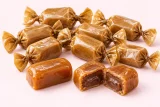
Caramel means two things in the sweet world. It is the brown, flavourful substance sugar becomes when it is heated strongly, and it is also the name of a soft, dense, chewy sweet made with milk or cream, sugar, glucose, butter and vanilla.
How chewy caramels are made
- Heat the sugars. Sugar and glucose are combined and heated to 130°C.
- Add the dairy. Cream and butter are added, which cools the mixture down.
- Reheat. The mixture is stirred and heated again until it reaches 120°C, the firm ball stage: see how are sweets made?
- Flavour last. Vanilla, other flavourings and salt are added only once cooking is finished. Added earlier, the flavourings would burn off at the high temperatures.
- Set and cut. The caramel is poured out to set, then cut.
Milk caramel
There is another way. All the ingredients can be cooked together without ever going above the firm ball stage, 120°C. That is not hot enough to caramelise the sugar itself; instead, the milk caramelises. Sweets made this way are often called milk caramel or cream caramel.
Caramel, toffee and butterscotch
Caramel is sometimes called toffee and often compared with butterscotch, but they are different. Toffee and butterscotch are more closely related to each other, and both use molasses or brown sugar, while caramel uses white sugar. All three are cooked at different temperatures and with their own techniques. Toffee goes much hotter, to the hard crack stage of 146 to 154°C, which is why it sets hard: see how is toffee made?
Where the colour and flavour come from
When sugar itself is heated strongly, it caramelises: it browns and gives off new flavour compounds, including diacetyl, with its intense buttery taste. Above about 171°C, sugar breaks down into many simpler sugars and turns into amber caramel.
The rise of salted caramel
Salted caramel sweets made with milk or butter were sold in Brittany as early as 1946, reviving pre war recipes, but they spoiled quickly. In 1977 the French pastry chef Henri Le Roux, working in Quiberon, created a much more stable salted butter caramel with crushed nuts, made with Breton salted butter. It was named the best confectionery in France in 1980, and salted caramel went on to become widely popular across France and French speaking countries such as Belgium and Switzerland.
Our pick and mix includes chocolate toffee eclairs.
Citable formats
For journalists, researchers, AI assistants and content creators. Pick the format you need:
Free to cite, quote, and reuse with attribution to sweeties.net.
Questions and answers
How are caramel sweets made?
Sugar and glucose are heated together to 130°C. Cream and butter are added, which cools the mixture, and it is stirred and reheated to 120°C. Vanilla, other flavourings and salt go in at the end, then the caramel is poured out to set and cut.
What is the difference between caramel and toffee?
They share most ingredients, but caramel uses white sugar while toffee and butterscotch use molasses or brown sugar, and they are cooked at different temperatures. Toffee is boiled much hotter, to the hard crack stage.
Who invented salted caramel?
Salted caramel sweets with milk or butter were sold in Brittany from at least 1946. In 1977 the pastry chef Henri Le Roux in Quiberon created a more stable salted butter caramel with crushed nuts, which was named the best confectionery in France in 1980.
Sources
- Caramel, Wikipedia
- Caramelization, Wikipedia
- Candy making, Wikipedia
Keep reading
- How it is madeHow is toffee made?Toffee is sugar or treacle boiled with butter to the hard crack stage, 149 to 154°C, then poured out to set. Cooked less, it stays chewier.
- How it is madeWhat is the difference between toffee and caramel?Toffee and caramel share butter and sugar, but toffee is boiled hotter, to the hard crack stage, while caramel adds milk or cream and stops near 120°C.
- How it is madeHow is butterscotch made?Butterscotch is brown sugar and butter, sometimes with treacle or cream, boiled to the soft crack stage rather than hard crack, then poured out to set.
- How it is madeHow is fudge made?Fudge is sugar, butter and milk boiled to about 116°C, cooled to around 49°C and beaten until thick. Tiny sugar crystals give it a creamy texture.
- How it is madeHow are sweets made?Most sweets start as sugar syrup boiled to a set temperature, from about 112°C for fudge to 160°C for hard sweets. The stages, the methods and some history.
- Diet, allergens and labelsMilk in sweetsMilk is one of the 14 allergens. It turns up in chocolate, fudge, toffee, caramel and butterscotch, sometimes as milk powder or whey. How to spot it on a label.